Yipods Insights · Dishwasher Pod Development
How Dishwasher Pods Are Developed for Different Markets and Water Conditions
An effective dishwasher pod is developed for the food people cook, the water entering their machine and the way they use it. Regional development connects these conditions to the formula, dose and capsule design.
Start with the Local Washing Task
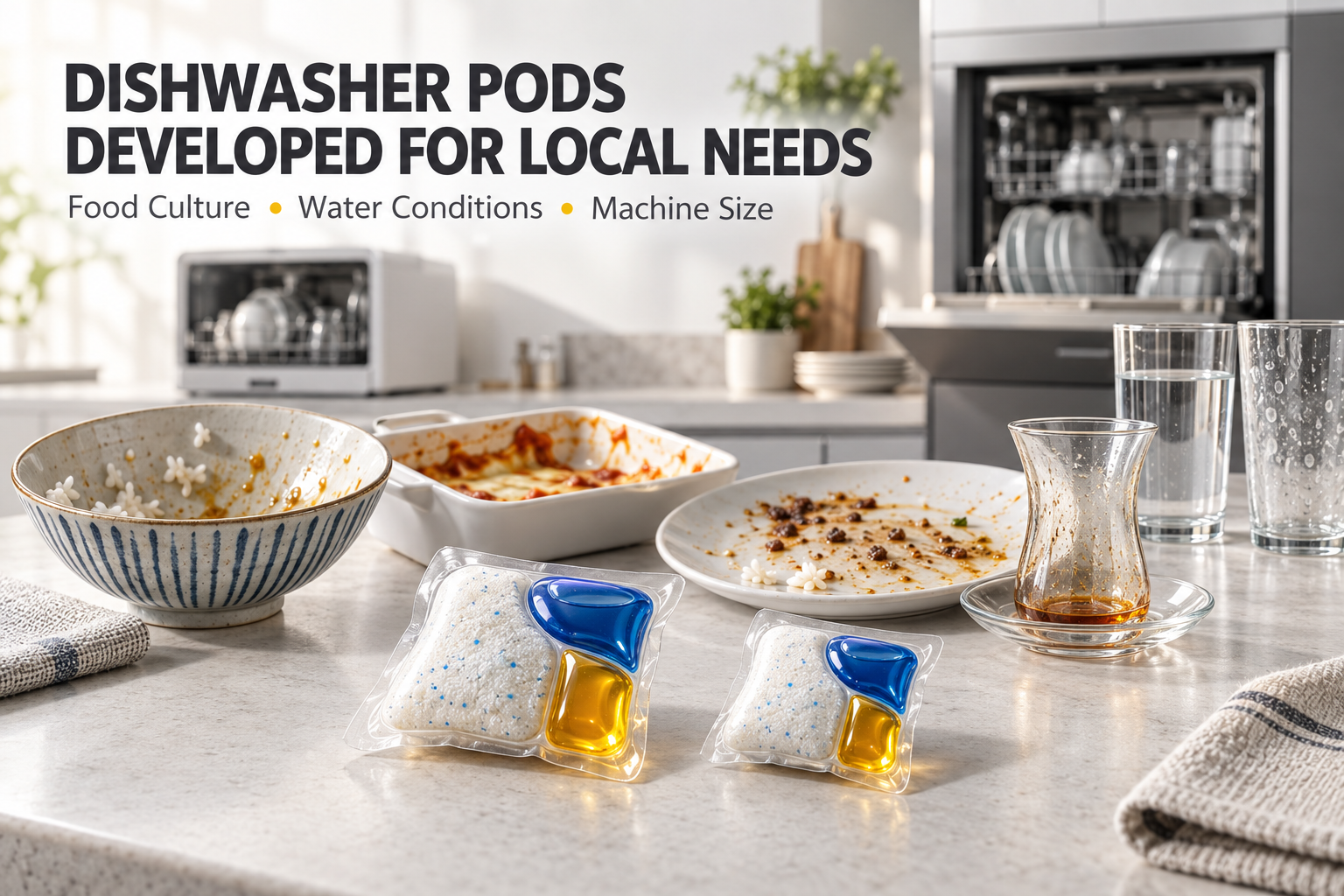
A formula developed for one market may need adjustment before it performs well in another. Rice dried onto a bowl, baked cheese on a dish and an oily roasting tray present different cleaning challenges. Water hardness and the selected wash cycle can change the result again.
Localization begins with three questions: what remains on the dishes, what happens inside the machine, and what result does the user expect? The answers determine the balance between enzymes, low-foam surfactants, alkalinity, water-hardness control, bleach chemistry and finishing performance.
Develop for a use case within a market: a compact machine washing rice bowls after every meal requires a different brief from a full-size machine washing dried cookware and glassware overnight.
Water Hardness: A Local Condition, Not a Country Label
Total hardness mainly reflects dissolved calcium and magnesium. These ions contribute to mineral deposits and can affect detergent performance. A suitable chelant and builder system, supported by dispersing polymers, helps manage the challenge. BASF identifies both metal-ion binding and scale/soil dispersion as relevant functions in automatic dishwashing.[T1]
The chart below compares documented local supplies in 15 countries. It is a selected global comparison rather than an exhaustive dataset for every country. A harmonized national-average dataset was not established for this article; assigning a single hardness figure to an entire country would hide important differences.
The background bands use USGS categories: soft up to 60 mg/L; moderately hard above 60 to 120; hard above 120 to 180; very hard above 180. Classification names differ between countries. German hardness was converted using 1 °dH = 17.848 mg/L CaCO₃; French hardness using 1 °f = 10 mg/L. Full sources, dates and sampling notes appear below.[T2]
Three Practical Lessons from the Data
- East Asia is not one water profile. Tokyo's utility reports an average around 60 mg/L. A published Seoul research sample measured 71 mg/L. Two Guangzhou plant reports show 41.4 and 142 mg/L at different plants and dates. These examples cannot support a single “East Asian” hardness specification.
- Europe includes soft and hard supplies. The Madrid network example records 43 mg/L, while Munich's published mean converts to about 282 mg/L and Paris Centre's 2023 mean to 286 mg/L. Regional formulation needs can differ substantially.
- The Middle East should not automatically be treated as very hard water. DEWA's Jebel Ali typical production figure is 60.7 mg/L. The 2025 report attributes this figure to 2023 station averages; its 40–120 mg/L specification is not an observed range. The Istanbul plant examples span 119–217 mg/L.
Measure the Water the Formula Actually Encounters
Tap-water data is the starting point. A dishwasher's built-in softener or a household treatment system can change the water reaching the wash chamber. Record softener settings, regeneration-salt use and residual hardness; also measure alkalinity, which is a different property from hardness. TDS alone is not a hardness measurement.
In hard-water applications, evaluate chelation capacity, scale inhibition and deposition on glass. In soft-water applications, optimize dosage and alkalinity without unnecessarily increasing chemical loading. Glass protection matters: persistent clouding from glass corrosion is different from removable mineral film.[T3]
Cooking Changes the Soil Before Washing Begins
The food name alone is not enough to define a test. Boiled starch, dried starch and baked starch behave differently. Heating can change proteins, while frying and roasting can leave oxidized or strongly adhered oily residues. Drying time further changes adhesion.
| Cooking or Use Condition | Residue to Evaluate | Formulation Direction |
|---|---|---|
| Rice, noodles and thickened sauces | Cooked and dried starch; starch–oil mixtures | Amylase activity under the actual temperature and wash time, supported by wetting and dispersion |
| Egg, fish, meat and dairy | Protein deposits, including heat-set protein mixed with fat | Protease selection, suitable alkalinity and low-foam surfactant performance |
| Stir-frying, roasting and grilling | Grease and strongly adhered heat-aged oily soils | Low-foam degreasing, alkalinity and anti-redeposition; test the toughest deposits separately |
| Tea, coffee and colored sauces | Colored organic deposits, often mixed with other food soils | Evaluate an oxygen-bleach system alongside soil-removal chemistry and material compatibility |
| Delayed washing | Dried-on starch, protein and composite soils | Wetting, enzyme performance and adequate contact time in the chosen program |
These directions are formulation hypotheses to test, not guaranteed solutions. Enzymes are substrate-specific; an amylase cannot replace a protease. Novonesis documents automatic-dishwash amylase performance for starch soils in shorter and cooler cycles, supporting cycle-specific enzyme selection.[T4] Fully carbonized residues require separate testing and may remain difficult even with a strong detergent.
Regional Food Cultures Suggest Different Test Panels
The following panels are proposed development priorities based on recognizable cooking patterns. They are not measurements of national soil prevalence. Each country contains diverse diets, so local customer interviews and household samples should determine the final weighting.
China: Starch, Stir-Fried Oils and Composite Sauces
A useful Chinese-market panel can include rice bowls, noodles, egg, stir-fry oil, starch-thickened sauces and hot-pot residues. For these combinations, prioritize amylase and protease performance together with controlled-foam degreasing and dispersion. Where cookware is included, add aged oily deposits and sauce films rather than testing only freshly oiled plates.
Regional diets and supply systems differ. The target city, household load and machine format should determine hardness control and dose. Bowl loading and spray access must also be checked: more detergent cannot compensate for surfaces that wash water does not reach.
Japan: Rice, Fish, Egg and Clear-Rinsing Performance
A Japanese-market panel can combine dried rice, fish and egg protein, oily grilled-fish residues, and soy-based sauces. Balance starch and protein removal with rinsing, low foam and finishing on the actual tableware. Include tea-stained cups if the intended household load makes them relevant.
Compact machines create a useful small-dose development opportunity. However, Tokyo's relatively low average hardness should not be applied to all Japanese locations or used as the sole reason to reduce the dose.
South Korea: Rice, Grilled Meat and Seasoned Mixed Soils
A Korean-market panel can include dried rice, grilled-meat fat and protein, egg, and chili-seasoned sauces mixed with oil. Test both removal of the food deposit and residual staining on dishwasher-safe plastics. Low-foam surfactants, enzymes, dispersion and an appropriate bleaching system should be assessed together; simply increasing bleach does not solve every colored-oil residue.
Match the test to the appliance segment. Samsung's Korean range includes countertop six-place-setting machines as well as larger built-in products, so a compact-dose brief should be separated from a full-size-machine brief.[T5]
Europe: Baked Food, Dairy Fats, Glassware and Eco Programs
A European-market panel can include pasta, baked cheese, milk, egg, roasting grease and tea or coffee deposits. Combine starch and protein removal with grease control and oxidative stain removal where appropriate. Glassware finishing and mineral-film prevention should be prominent in harder-water applications.
Test the actual eco program. Lower temperature does not necessarily mean a shorter cycle, and a longer cycle can change how the formula develops its cleaning effect. Verify dissolution, enzyme activity and bleaching under the measured temperature–time profile rather than assuming a common European washing condition.
Middle East: Rice, Roasted Meats, Legumes and Tea or Coffee
A Middle Eastern panel can include rice, roasted or grilled meat, oily stews, chickpea or other legume residues, and tea or coffee deposits. These mixed soils suggest testing amylase, protease, low-foam degreasing and oxidative stain removal in combination.
Distinguish desalinated municipal supplies from groundwater-based or blended systems. Develop hardness control around local measurements, and validate larger meal loads or delayed washing where household research identifies them. Storage trials should also reflect the temperature and humidity encountered in the distribution channel.
Why Compact Dishwashers Create Demand for Smaller Pods
Compact formats are a real product segment in China, Japan and South Korea. Midea lists a six-place-setting tabletop model in China; Panasonic documents an 18-item compact model in Japan; Samsung markets a six-place-setting countertop model in Korea.[T5] Their existence supports a targeted small-pod opportunity, but does not establish that compact machines dominate these markets.
A pod designed for a different machine and load may be unnecessarily large for a compact application. A smaller, purpose-developed pod can offer convenient dosing and fit a smaller dispenser while retaining the balance of ingredients required for cleaning.
Size the dose around main-wash water volume, soil load, residual hardness and cycle conditions. Total cycle water includes rinses and should not be used as the detergent dilution volume.
For illustration only, 6 g in a 3 L main wash and 12 g in a 6 L main wash both give 2 g/L of product. This arithmetic is not a dose recommendation: the two loads may have different food-soil and mineral demands, and ingredient activity still matters.
Panasonic's compact-model specification mentions approximately 4 g of dedicated detergent in a particular test. It demonstrates that low-dose testing exists, not that every compact dishwasher should use a 4 g pod.[T5]
- Optimize the composition: maintain the required enzyme, bleach and hardness-control capacity at the proposed dose.
- Optimize delivery: verify capsule dimensions, dispenser opening, film dissolution and powder residue in the shortest relevant cycle.
- Control foam and rinsing: evaluate the formulated product and food soils together under the appliance's spray conditions.
- Define clear use instructions: specify the intended machine and load; validate a separate full-size product where needed.
Develop an appropriately sized capsule rather than relying on users to cut open or split an existing water-soluble pod.
Use Habits Create Additional Formulation Requirements
| Observed Habit or Machine Condition | Development Response | What to Verify |
|---|---|---|
| Frequent small loads | Dedicated compact dose and appropriate capsule dimensions | Cleaning, rinsing and dose sufficiency at both light and heavy soil loads |
| Quick program | Rapid dissolution and ingredients effective within the available wash window | Release timing and cleaning before the main wash drains |
| Eco or lower-temperature program | Cycle-specific enzymes and bleaching performance | Actual temperature profile, contact time, residue and finishing |
| Dishes left until evening | Stronger dried-on-soil test panel | Repeatable drying/aging conditions and removal of mixed soils |
| Pre-rinsing or residual hand-dishwash liquid | Validate both lightly soiled loads and surfactant carryover | Foam, spray performance and appropriate dosing instructions |
| Softener or rinse-aid use varies | Test realistic appliance settings and finishing systems | Residual hardness, spotting, drying and glass protection |
“All-in-one” performance should be evaluated together with the appliance. Detergent hardness control does not regenerate an ion-exchange softener; regeneration salt serves that separate function. A benefit delivered mainly in the wash cannot automatically replace a rinse aid dispensed in the final rinse.[T3]
A Practical Local Development Workflow
- Build the market brief. Identify the target appliance segment, household size, common foods, washing frequency and desired product claims.
- Measure local conditions. Collect utility data and household samples; record hardness, alkalinity, softener settings and distribution/storage conditions.
- Create a reproducible soil panel. Combine standard benchmark soils with local food residues, defined cooking methods and controlled drying times.
- Develop formula and dose together. Optimize hardness control, enzymes, low-foam surfactants, alkalinity, bleach and finishing around the intended wash.
- Validate the complete pod. Test storage stability, film compatibility, dissolution, cleaning, foam, spotting, corrosion and production consistency.
- Confirm in real homes. Compare the proposed product with a relevant market benchmark and use feedback to refine the formula and instructions.
The result should be a product built around an observable local need. This may be a small pod for compact machines, a formula for dried starch and oily sauces, or a hard-water product with stronger finishing performance. The target is the best result for the intended washing task at a competitive cost per wash.
Water Data and Source Notes
Research checked 1 October 2026. Reports differ in year, location, sampling point and statistic. No midpoint was substituted for a missing mean. Ranges represent the source's stated range or the spread across reported plant figures, not population-wide confidence intervals. The table documents these differences.
View all 17 supply examples, sources and sampling notes
| Country / Source ID | Location and Hardness | Period and Statistic | Source and Limitations |
|---|---|---|---|
| [W1] China | Guangzhou · eastern plant 41.4 mg/L CaCO₃ | Jul 2025 Reported plant result | Guangzhou Water Affairs BureauXizhou water plant outlet; eastern Guangzhou supply zone. Not a Guangzhou-wide average. |
| [W2] China | Guangzhou · northern plant 142 mg/L CaCO₃ | Nov 2025 Reported plant result | Guangzhou Water Affairs BureauNorthern water plant outlet; Baiyun supply zone. Different date and plant from the eastern example. |
| [W3] Japan | Tokyo · supplied taps 60; range 25.3–87.6 mg/L CaCO₃ | FY2023 Approximate mean; observed limits | Tokyo Metropolitan WaterworksUtility states average around 60 mg/L; FY2023 lowest and highest tap results 25.3 and 87.6. |
| [W4] South Korea | Seoul · study sample 71 mg/L CaCO₃ | 2022 paper Research sample | Yan et al., Frontiers in MicrobiologyTable 1 tap-water sample. Sampling year is not specified here; 2022 is publication year. Not a municipal average. |
| [W5] Singapore | Waterworks / desalination output 42.7; range 7.24–191 mg/L CaCO₃ | 2025 Mean; observed range | PUB2025 production water report, not every consumer tap. |
| [W6] Germany | Munich 282.1; range 248.2–319.6 mg/L CaCO₃ | Utility page Mean; published range | Stadtwerke München15.8 degrees dH mean, range 13.9–17.9 degrees dH; converted using 1 degree dH = 17.848 mg/L CaCO3. |
| [W7] Netherlands | Amsterdam · Waternet 139.2 mg/L CaCO₃ | Utility page Published supply value | Waternet7.8 degrees dH, converted using 17.848 mg/L per degree dH. Utility's local hardness classes differ from USGS classes used in the chart. |
| [W8] Austria | Vienna · usual supply No mean reported; range 107.1–214.2 mg/L CaCO₃ | Utility page Usual supply range | City of ViennaUsual 6–12 degrees dH. Exceptional groundwater supply can reach 20 degrees dH (~357 mg/L); this exceptional maximum is not plotted. |
| [W9] Spain | Madrid · network 268 43 mg/L CaCO₃ | Apr 2026 Reported network test | Spanish Ministry of Health, SINACResult dated 15 April 2026 for the listed Madrid distribution network, not a national average. |
| [W10] France | Paris · Centre supply zone 286 mg/L CaCO₃ | 2023 Annual mean | ARS / Eau de ParisReport issued 20 March 2024 for 2023 water quality. Mean 28.6 degrees f; maximum 31.6 degrees f. 1 degree f = 10 mg/L CaCO3; no minimum supplied here. |
| [W11] Greece | Vasiliko · DEYAX 345 mg/L CaCO₃ | Jul 2025 Reported local test | Municipal water utility DEYAXJuly 2025 local drinking-water report. Not a Greece-wide average. |
| [W12] Türkiye | Istanbul · treatment plants No mean reported; range 119–217 mg/L CaCO₃ | Jul 2025 Range across plant results | İSKİMinimum and maximum of 13 total-hardness entries in the July 2025 report. No weighted city mean calculated. |
| [W13] UAE | Dubai · Jebel Ali production 60.7 mg/L CaCO₃ | 2023 data* Mean of station means | DEWA 2025 Sustainability Report2025 report p.58 footnote attributes typical figures to 2023 station averages. 40–120 mg/L is a specification, not an observed range; it is not plotted. |
| [W14] South Africa | Cape Town · production plants No mean reported; range 20–88 mg/L CaCO₃ | 2024 Range across plant averages | City of Cape TownRange of the ten published production-plant hardness figures: 24,35,32,22,36,20,88,44,53,42 mg/L. Not an observed household minimum/maximum. |
| [W15] Australia | Greater Sydney 57 mg/L CaCO₃ | Utility page Approximate supply value | Sydney WaterUtility states approximately 57 mg/L. Page does not specify a single reporting year for this typical value. |
| [W16] USA | South San Francisco · SFPUC 62; range 8.1–112 mg/L CaCO₃ | 2025 Mean; observed range | California Water ServiceSFPUC supply component in the South San Francisco system report; not a citywide blend or national average. |
| [W17] USA | South San Francisco · groundwater 384; range 287–461 mg/L CaCO₃ | 2025 Mean; observed range | California Water ServiceGroundwater supply component in the same system report. Consumer blend depends on supply configuration. |
Technical and Appliance References
- [T1] BASF: Trilon® M EcoBalanced and Sokalan® CP 50 — chelation, scale control and soil dispersion.
- [T2] USGS: Hardness of Water — classification and local measurement context.
- [T3] Bosch: Glass corrosion, dishwasher salt and rinse aid.
- [T4] Novonesis: Achieve® Alpha 100 L — automatic-dishwashing amylase.
- [T5] Appliance examples: Midea M30, China; Panasonic NP-TCR4, Japan; Samsung dishwasher range, South Korea. Product examples establish available formats, not their national market share.