
How to Start a Laundry Pod Brand: From Product Concept to Mass Production
Laundry pod manufacturing is already mature in many markets. A new brand therefore cannot behave as if it were entering an empty category. It must first find a credible market gap, turn that opportunity into a manufacturable product and validate demand before scaling.
Start with the market, not the product
Do not begin by requesting a machine quotation or choosing from an OEM catalogue. First study the environment in which the product will compete and identify what existing brands serve poorly.
Collect products from supermarkets, e-commerce platforms, local detergent companies, imported brands and private-label suppliers. Build a simple competitor database that makes crowded areas and underserved needs visible.
Chamber structure, pod weight, dose count, liquid or powder–liquid format.
Cleaning claims, fragrance positioning, target user and recurring complaints.
Retail price, cost per wash, pack count, channel and promotional strategy.
Packaging format, visual identity, ingredient story and product experience.
If every competitor offers a similar three-chamber pod with the same claims, another visually similar product will probably enter price competition. The opportunity lies in a specific problem, audience or experience that the established products do not serve particularly well.
Define a clear reason to exist
Product uniqueness does not always require a new chemical technology. It can come from solving a familiar problem in a more relevant, memorable or credible way.
Laundry Sauce: fragrance as the center of the brand
Laundry Sauce in the United States does not compete only through general cleaning claims. It makes fragrance and the laundry experience central to its identity.
Fragrance is personal, emotionally visible and expandable into multiple product variations. That gives the brand a recognizable territory with room for continued growth.
FGB Australia: eucalyptus heritage turned into a product
FGB had an established connection with eucalyptus oil and a long local heritage. The project combined this recognizable ingredient, the existing brand story and a distinctive pod design.
The result was more than another laundry capsule: it became a product consumers could connect with an existing identity and a specific functional ingredient.
Convert the brand idea into a product brief
A good concept must become a set of measurable requirements. This gives the formulation, mold, packaging and manufacturing teams something concrete to evaluate.
A practical brief should define
- Target consumer and main problem
- Primary product promise
- Target retail price and cost per wash
- Cleaning-performance level and recommended dose
- Pod weight and chamber structure
- Liquid, powder or powder–liquid architecture
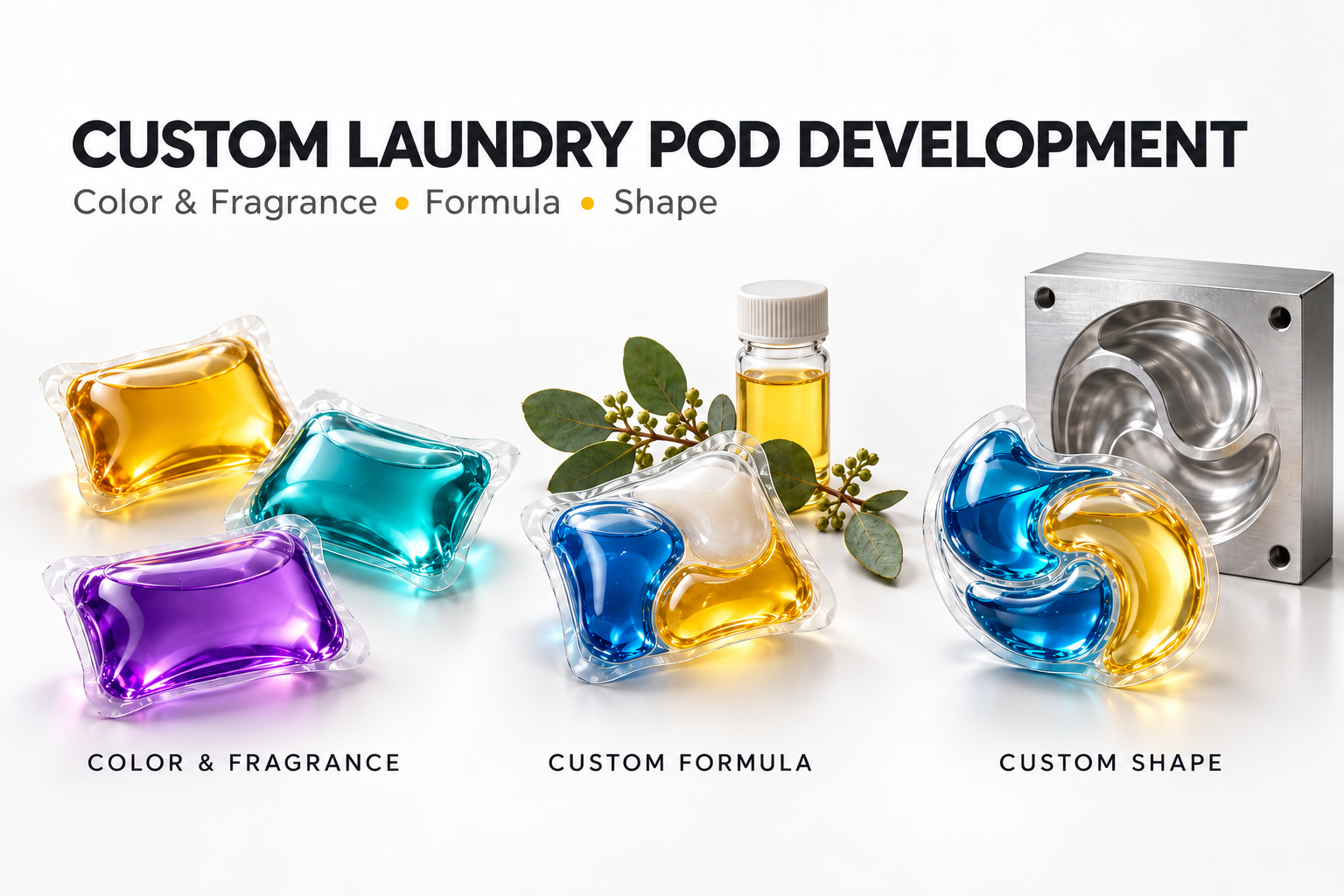
- Fragrance, appearance and color direction
- Packaging format and pack count
- Sales channel and initial volume
- Certification and market-compliance needs
“A premium 14–16 g laundry pod for urban households, positioned around eucalyptus freshness, everyday stain removal and color care, sold through pharmacies and online channels in a moisture-resistant recyclable carton.”
Balance three connected requirements
Many product ideas look attractive in a presentation but become difficult at the factory. A viable product must sit at the intersection of three areas.
Product uniqueness
Does the product have a clear difference from existing alternatives? Is the difference important enough to support a brand rather than being only a minor technical detail?
Consumer perception
Can consumers see, smell, understand or experience the difference? A technically advanced ingredient has limited commercial value if its benefit cannot be explained or demonstrated.
Manufacturing feasibility
Can the formula remain stable inside PVA film, fill and seal reliably, use available raw materials and reach an acceptable cost and production yield?
A highly distinctive idea that cannot be manufactured reliably is not yet a product. A product that is easy to manufacture but invisible to consumers is unlikely to build a brand.
Understand the cost of complexity
Laundry pods are becoming more sophisticated, but every additional chamber, material and process creates extra development work, manufacturing risk and minimum efficient volume.
| Architecture | Main advantage | Manufacturing implication | Best use |
|---|---|---|---|
| 1Single liquid chamber | Lowest structural complexity and broad manufacturing availability | Simpler mold, filling and process control | Fast market entry |
| 2Multi-liquid chambers | Function separation and stronger shelf impact | More complex mold, dosing and formula balance | Visible differentiation |
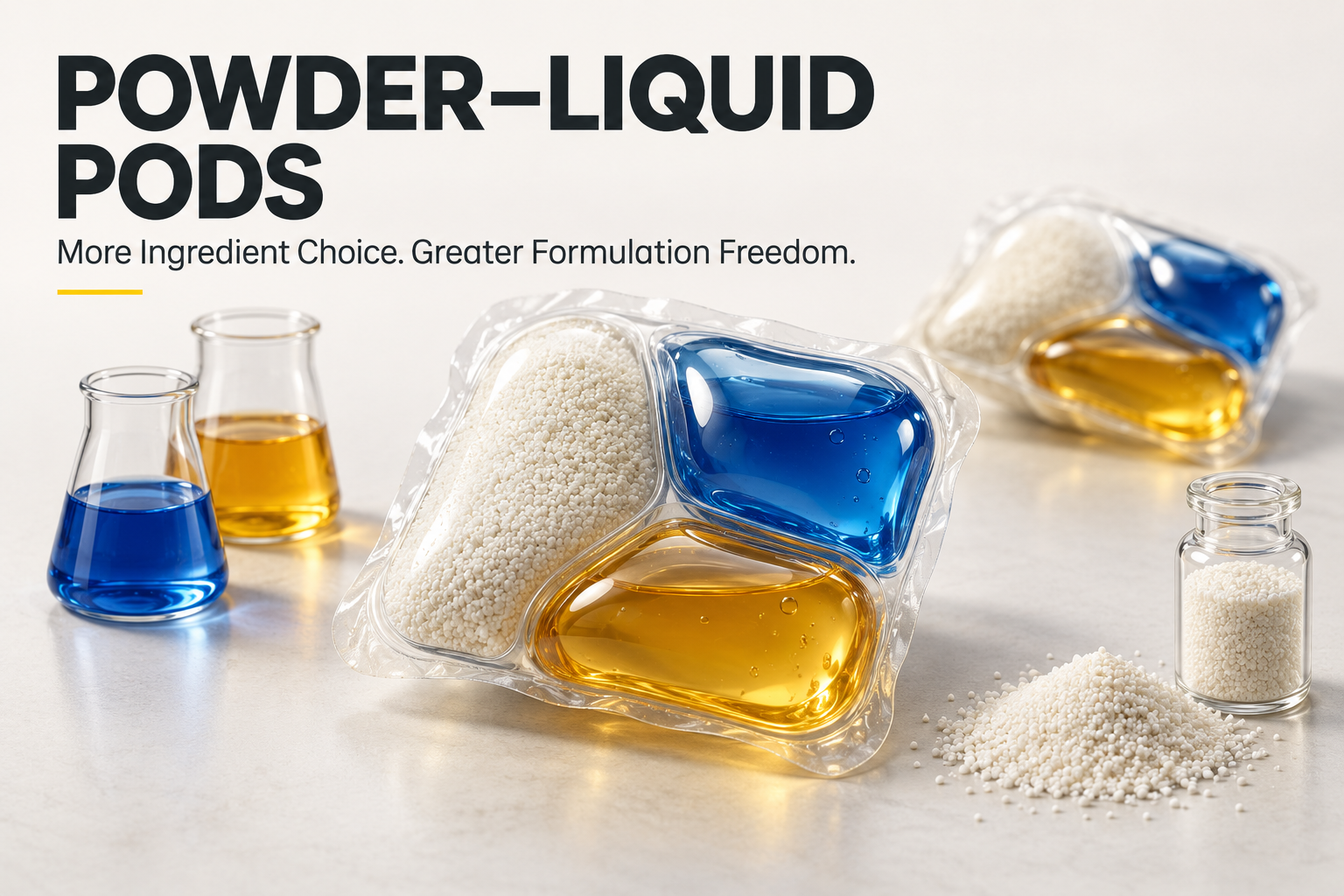
| 3Powder–liquid system | More formulation freedom and functional separation | Powder handling, humidity control and tighter sealing requirements | Performance differentiation |
| 4Dual powder + multi-liquid | Separates catalysts, enzymes, bleach, surfactants and care ingredients | Advanced equipment, more validation and tighter process control | Advanced functional system |
The objective is not to create the most complex pod possible. Use only the complexity required to deliver a difference that consumers can recognize and value.
Confirm feasibility with the manufacturing partner early
Once the positioning is clear, involve the formulation and manufacturing team before locking the formula, shape or packaging concept.
Formula and PVA compatibility
- Viscosity, water activity and ingredient solubility
- Fragrance, color and cross-chamber migration
- Film stability, sealing and storage behavior
- Raw-material availability and qualified alternatives
Equipment and commercial feasibility
- Powder and liquid dosing consistency
- Chamber volume and ingredient ratios
- Mold and equipment capability
- Packaging moisture protection
- Realistic unit cost at the expected volume
Validate before committing to mass production
Prototype work is not merely sample preparation. It is the bridge between a brand story and an industrial product.
Use the lowest-cost credible route to market
The first objective is not maximum automation or maximum technical complexity. It is to place a credible product in front of real customers at a manageable cost.
A sensible first launch may use
- An existing pod structure with a customized formula
- A standard mold with differentiated fragrance and packaging
- Small-batch production for market validation
- A limited number of SKUs
- One clearly defined sales channel
- A staged transition from prototype to full production
Prepare for future scale
- Define which parameters must remain fixed
- Qualify alternative raw materials
- Confirm compatibility with faster equipment
- Check packaging capacity at higher volume
- Build measurable quality standards
- Record complaints and market feedback systematically
The best first product is not necessarily the most advanced one. It is the simplest product that can communicate the brand’s difference and deliver the promised consumer experience.
From an idea to a manufacturable brand
Mass production is not the end of development. Real storage conditions, packaging behavior, consumer preference, dissolution habits and channel feedback reveal information that laboratory testing cannot fully predict. Strong brands connect this market information back into product development.
Turn a differentiated idea into a manufacturable product
Yipods supports projects from early product definition and prototype development to formulation, chamber structure, mold, packaging and manufacturing coordination—whether the starting point is a proven private-label format or an advanced powder–liquid system.