How Much Does It Cost to Manufacture Private-Label Laundry Pods?
The answer depends less on the word “private label” and more on one practical question: how much of the existing product do you want to change?
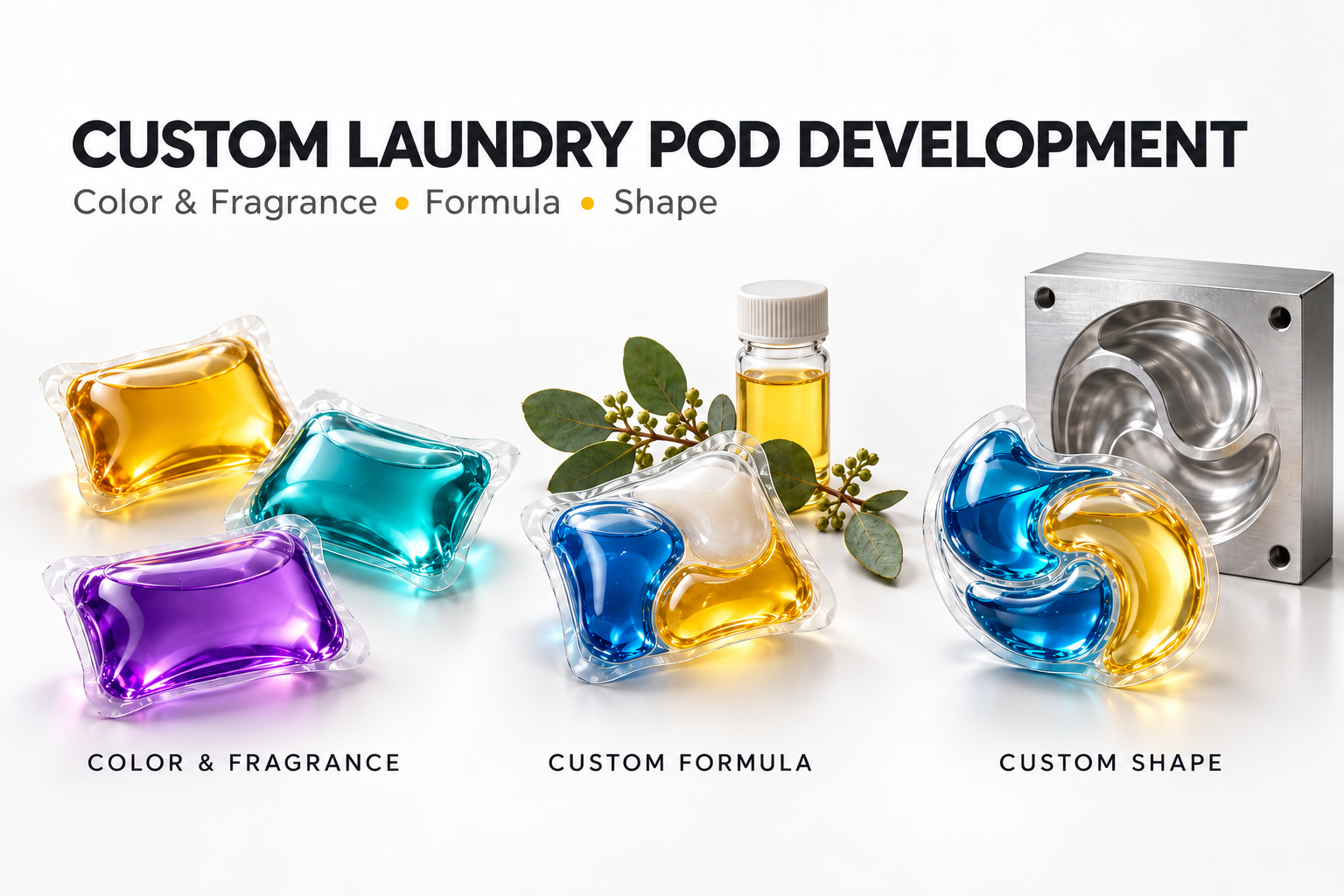
Four levels of laundry pod customization
A brand can enter the market with an already validated product and new packaging, or develop a completely new formula, chamber structure and mold. The technical risk, MOQ and time to market are very different.
| Level | What changes | Typical entry budget | Typical volume requirement |
|---|---|---|---|
| 1Packaging only | Brand, artwork and external packaging | USD 5,000–8,000 | Lowest and most flexible |
| 2Color + fragrance | Packaging plus sensory identity | Around USD 10,000 | Higher than packaging-only |
| 3Custom formula | Formula, claims and performance direction | Usually above USD 20,000 | Commonly above 1 million pods |
| 4Formula + mold | Formula, chamber structure and unique shape | Close to USD 40,000 | Often near 5 million pods per year |
Important: these are indicative project-entry budgets, not fixed quotations or total order values. The commercial product order, packaging, freight, duties, taxes and market-specific compliance work may be additional.
What changes at each level?
Keep the product and change only the packaging
The simplest route is to use a manufacturer’s existing, validated laundry pod and change only the external packaging. The formula, pod weight, chamber structure, shape, fragrance, color, PVA film and production process remain unchanged.
Because no formula or process change is required, the technical risk is low. The additional budget mainly covers brand and packaging work, such as artwork adaptation, printing setup, custom bags, tubs or cartons, and packaging minimum order quantities.
Best for
- Influencers and creators with an existing audience
- Online sellers and distributors
- New brands validating market demand
- Projects where speed matters more than exclusivity
Trade-off
- Product differentiation depends on brand and packaging
- The same base product may be available to other brands
- Claims are limited by the existing formula
- Direct price comparison may become difficult to avoid
Customize the color and fragrance
Changing color and fragrance can create a more recognizable sensory identity without redesigning the complete formula. Fragrance is especially valuable because consumers perceive it immediately and can associate it strongly with the brand.
However, these changes are not purely cosmetic. A new fragrance may affect viscosity, PVA-film compatibility, seal stability, ingredient solubility and storage odor. Colorants can migrate between chambers or interact with the formula and film.
Develop a custom laundry pod formula
Once the formula changes, the project becomes a genuine product-development program. A custom formula may be needed for stronger stain removal, low-temperature cleaning, a specific enzyme system, fabric care, sensitive-skin positioning, regional water conditions or powder–liquid functionality.
A successful formula must deliver performance while remaining compatible with PVA film, production equipment, storage and transport. It must also comply with destination-market regulations and reach an acceptable manufacturing cost.
Typical development work
- Competitor benchmarking and product brief
- Laboratory formula and sample development
- Cleaning-performance evaluation
- PVA compatibility and accelerated stability tests
- Production trials and specification confirmation
Why MOQ increases
- Supplier MOQ for special raw materials
- Dedicated inventory and unused stock risk
- Separate batching, cleaning and quality control
- Commissioning loss and possible production waste
- More validation and regulatory work
Develop a custom formula and custom pod shape
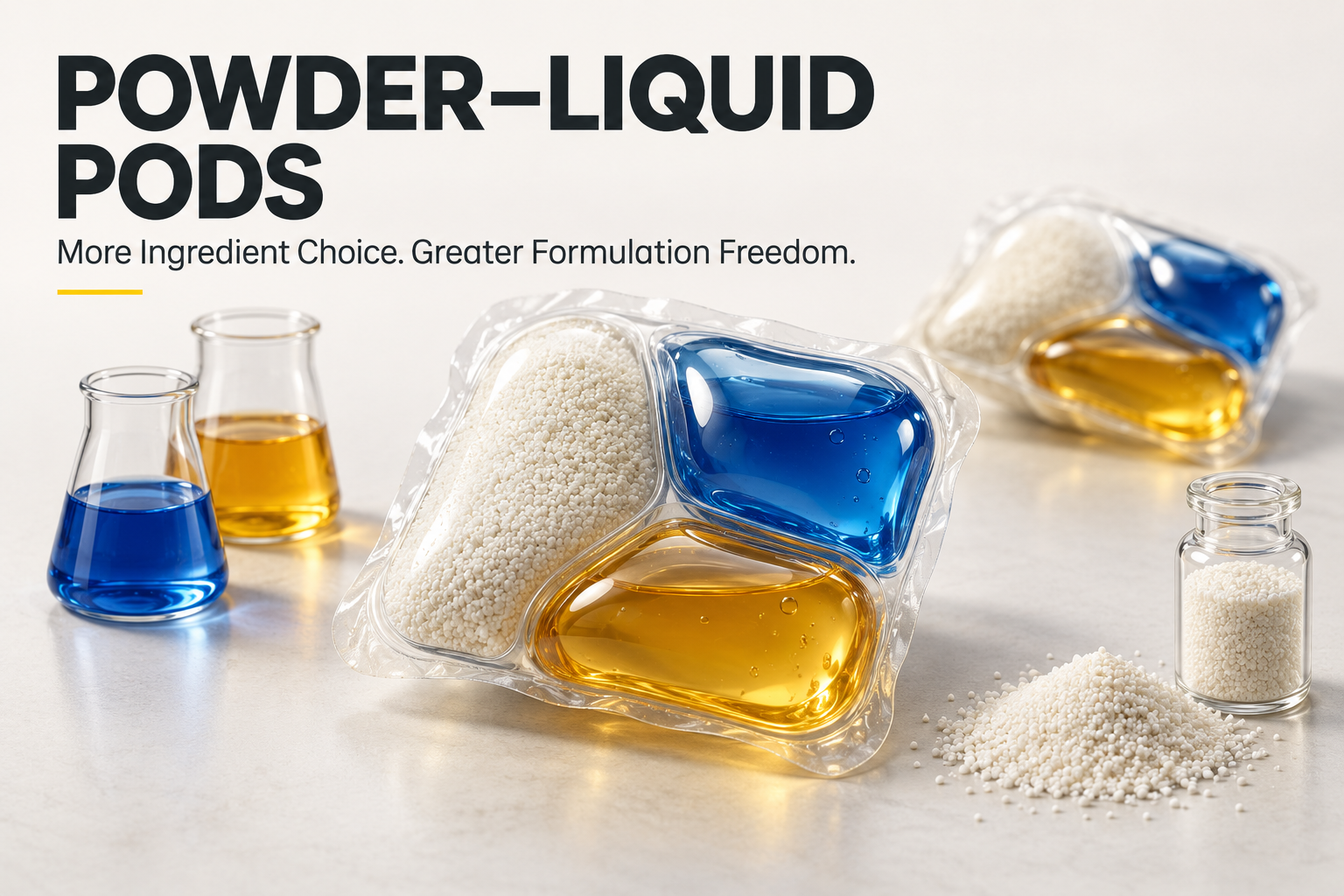
The highest level of customization combines formulation development with a dedicated shape, chamber structure and production mold. It can include a proprietary external profile, custom volume ratios, powder and liquid separation, or two powder chambers with multiple liquid chambers.
The formula and mold must be developed as one system. Chamber volume determines the dose of each phase, while formulation properties affect forming depth, filling behavior, sealing and storage stability. A change in one area can require engineering changes elsewhere.
A commercial mold can cost close to USD 20,000, depending on machine format, width, cavity count, chamber complexity and precision requirements. The complete program may also require pod design, engineering drawings, trials, filling-system modifications and production commissioning.
An expected annual volume near 5 million pods does not always mean one shipment. It may be divided into planned production batches when the annual forecast and purchasing commitment justify the dedicated tooling and resources.
What determines the cost per pod?
As a general reference, laundry pods typically cost USD 0.06–0.12 per pod to manufacture. Basic validated formulas are more likely to sit near the lower end; premium ingredients and complex structures move toward—or sometimes beyond—the upper end.
Formula
Surfactants, polymers, enzymes, fragrance, catalysts, bleaching systems and specialty additives can have very different costs.
Pod weight
A 20 g pod normally consumes more formula and film than a 12 g pod. Reducing weight without redesigning concentration may reduce performance.
Chamber structure
Single-chamber pods are simpler. Multi-chamber and powder–liquid products need more dosing stations, control and mold complexity.
PVA film
Film grade, thickness, stretching requirement and forming depth influence material consumption, sealing and production reliability.
Production efficiency
Long stable runs reduce setup loss and labor per unit. Small orders, frequent changes and difficult formulas increase cost.
Packaging and logistics
Pouches, tubs, cartons, pack count, printing MOQ, freight, tariff and local tax all affect the final landed cost per wash.
Factory price is not landed cost. Always confirm whether the quotation includes primary and secondary packaging, testing, freight, insurance, import duties and taxes.
Select the right route for your current stage
The goal is not to maximize technical complexity. It is to use the minimum level of customization that creates a credible reason for the consumer to buy.
Packaging-only private label
- The market has not yet been validated.
- Speed matters more than exclusivity.
- You already have an audience or sales channel.
- The initial budget is limited and flexible MOQ is important.
Color and fragrance customization
- Sensory identity is important to the brand.
- The existing formula already meets the performance target.
- You need a more recognizable product.
- The project can support extra testing and dedicated inventory.
Custom formulation
- Performance is central to the brand promise.
- Existing products cannot support the intended claims.
- The market opportunity is sufficiently large.
- The project can support an MOQ above 1 million pods.
Custom formula and mold
- Shape and chamber architecture create real differentiation.
- Formula functions require physical separation.
- The brand can support substantial annual volume.
- Long-term value justifies tooling and engineering investment.
Higher development cost can create stronger differentiation
A packaging-only product is fast and affordable, but competitors may be able to launch something similar. A proprietary formula and recognizable pod shape can support more specific claims, reduce direct price comparison and give the brand clearer material for advertising, demonstrations and retailer presentations.
That does not mean every project should become more complex. Every additional chamber, ingredient and structural feature should create a benefit that consumers can understand and value.
For many new brands, the most sensible path is to launch with the minimum necessary complexity, validate real demand, and then invest in proprietary formulas or tooling when sales can support the additional cost.
Plan the right private-label route
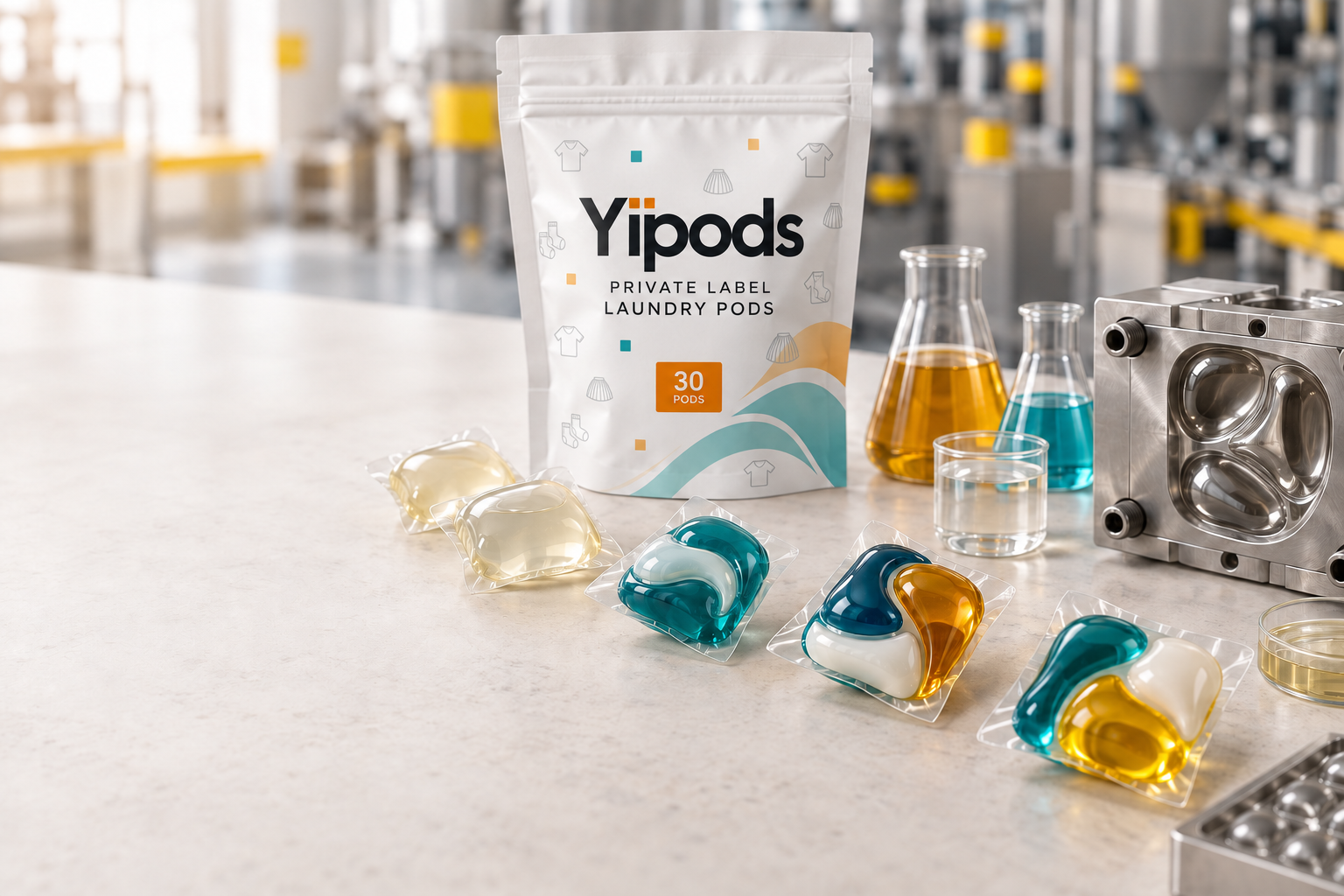
Yipods supports packaging-only private label, sensory customization, proprietary formulas, powder–liquid structures and custom pod molds. Share your target market, packaging format, expected volume and required level of customization so we can identify the most practical route.