Yipods Insights · Formulation Technology
Powder–Liquid Pods: Why Hybrid Formulations Enable Better Cleaning Performance
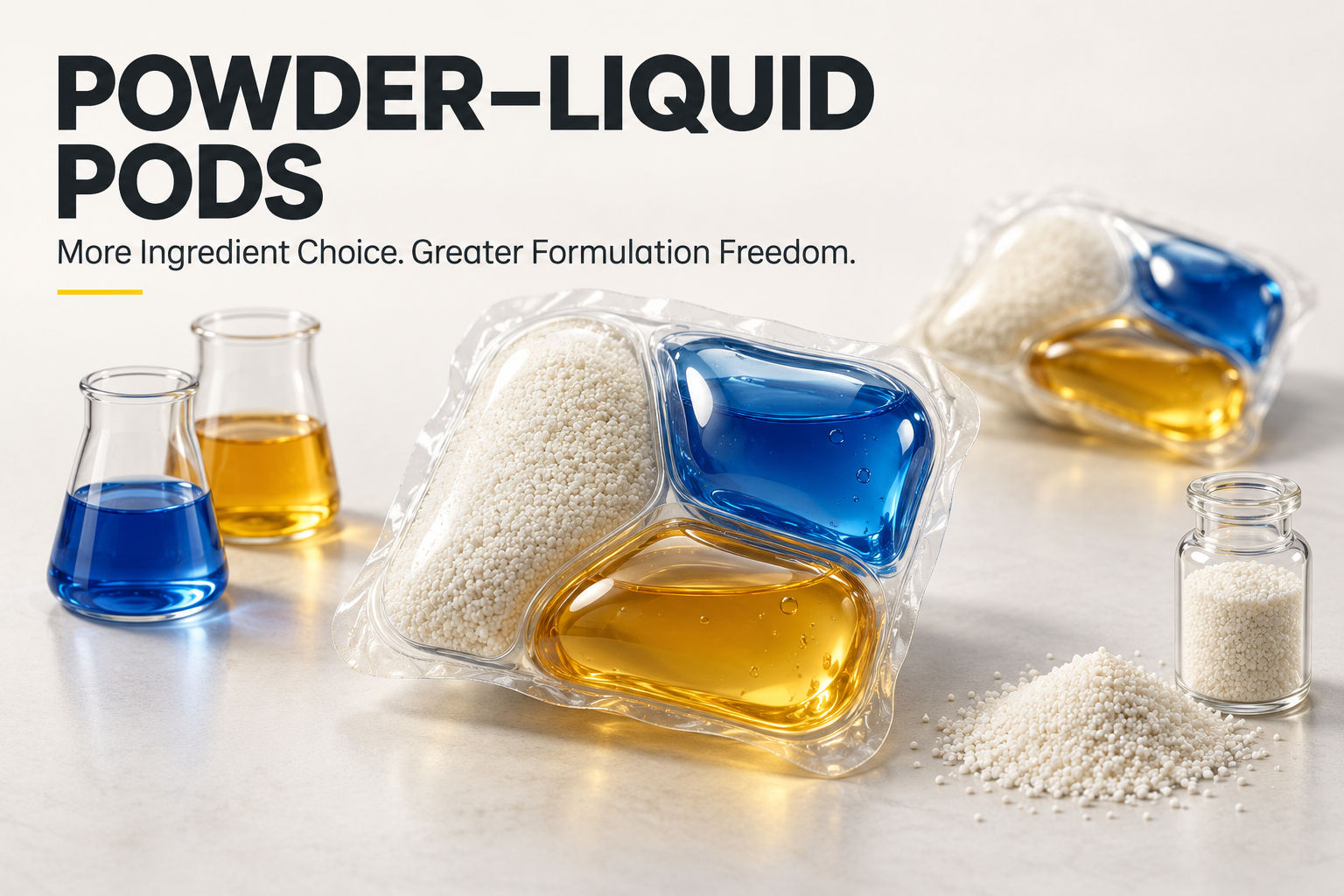
Powder–liquid pods change how a detergent can be built. By combining separately formulated powder and liquid compartments, they give developers a broader ingredient toolbox and more freedom to deliver the performance customers need.
A Different Architecture for Detergent Formulation
Traditional detergent development often asks many ingredients to coexist in a single formulation environment throughout storage. Cleaning agents, enzymes, builders and other performance ingredients must work together while also meeting the product's stability and processing requirements.
This creates compromises. An ingredient may be useful in the wash but difficult to incorporate into the chosen product format. Developers may need to change its form, reduce its dosage, add supporting materials or leave it out altogether.
Powder–liquid pods offer another approach: allocate ingredients to compartments and physical forms that better suit their requirements, then deliver them together in one dose. The architecture expands what the formulation engineer can use and how those ingredients can be combined.
The central advantage is formulation freedom: choose ingredients for their contribution to cleaning, then build a suitable storage and delivery system around them.
Why Powder–Liquid Goes Beyond All-Liquid Multi-Chamber Pods
All-liquid multi-chamber pods can separate different liquid formulations and create useful opportunities for differentiation. However, each compartment still needs a fillable liquid formulation that remains compatible with the film and stable during storage.
Adding a powder compartment introduces a different formulation environment. Ingredients that are difficult to use in a concentrated liquid can be evaluated in a dry system alongside liquid ingredients selected for their own strengths.
| Development Area | All-Liquid Multi-Chamber Pods | Powder–Liquid Pods |
|---|---|---|
| Ingredient selection | Ingredients must fit the requirements of the liquid compartments. | Developers can evaluate both dry and liquid ingredient systems. |
| Storage environment | Separate liquid compartments can reduce direct contact between selected ingredients. | Powder and liquid compartments provide additional choices for ingredient allocation. |
| Functional design | Performance is developed within liquid formulation constraints. | Functions can be distributed across dry and liquid formulations. |
| Oxygen bleach options | Sodium percarbonate is difficult to stabilize in conventional liquid detergent systems. | A suitable powder compartment opens a route to percarbonate-based bleach systems. |
| Cost optimization | Optimization uses ingredients and supporting materials suitable for liquid formulations. | A wider toolbox creates more options to optimize cost for a defined cleaning result. |
| Manufacturing requirements | Liquid dosing, film forming and sealing must be controlled. | Powder dosing, dust control and powder–liquid integration add engineering requirements. |
These are formulation opportunities, not automatic performance rankings. The result depends on ingredient selection, compartment design, dissolution and production quality.
A Broader Toolbox for Cleaning Performance
Oxygen Bleach in a Suitable Dry System
Sodium percarbonate is a practical example of an ingredient whose physical environment matters. Solvay's technical information describes coated, stabilized grades for detergent powders and tablets, with bleaching activity against stains such as tea, coffee, wine and fruit. A powder compartment creates an opportunity to incorporate this type of chemistry alongside a separately formulated liquid system.[1]
Bleach activators such as TAED may also be considered where the formulation and intended washing conditions support their use. The finished pod still needs validation for moisture control, storage stability, dissolution and fabric suitability.
Complementary Cleaning Functions in One Dose
Liquid compartments can carry suitable surfactant systems and compatible performance ingredients. A powder compartment can carry selected dry ingredients that contribute additional functions. This allows developers to consider combinations of oily-soil removal, enzymatic cleaning and oxidative stain removal within one convenient product.
Enzymes already have an important role in liquid detergents; hybrid architecture does not make them exclusive to powder. BASF describes different enzymes targeting different stain components. Their location in a hybrid pod should therefore be chosen according to the specific formulation and compatibility requirements.[2]
More Compartments Where Separation Adds Value
Where one powder blend still requires too many compromises, an additional powder compartment can provide another separation option. The purpose is to give ingredients a more suitable storage environment. Adding compartments is valuable when it solves a real formulation problem and produces a measurable benefit.
Make Better Use of Each Ingredient
Ingredient efficiency means the useful cleaning contribution delivered by the material, rather than simply the percentage added to a formula. A valuable ingredient must retain its activity during storage, be released during washing and perform under the intended conditions.
Hybrid architecture gives developers more ways to meet those requirements. It can reduce the need to force every ingredient into a liquid-compatible form and create opportunities to reduce supporting solvents or other formulation aids where they are no longer needed.
The combination also makes it possible to evaluate cleaning effects that are difficult to achieve in a conventional all-liquid structure. A broader toolkit allows performance to be designed around the stain and washing conditions, rather than around the limitations of a single physical format.
Better ingredient utilization: retain activity during storage, deliver the ingredient effectively in the wash and use its contribution to meet a defined performance target.
How Hybrid Formulations Can Reduce Lifecycle Cost
The commercial opportunity extends beyond a higher-performing pod. More ingredient choices and better utilization can create routes to a lower total cost for delivering the required cleaning result.
Formulation Cost
Compare more raw materials and physical forms. Optimize the complete formula for a defined result, including the cost of ingredients needed to support stability and processing.
Production and Storage
Evaluate usable output, dosing accuracy, rejects and retained performance over shelf life. Better stability can support lower losses when demonstrated by testing.
Cost in Use
Measure the dose needed for effective cleaning. If testing shows that a product supports lower-temperature washing or fewer rewashes, include those benefits in the comparison.
Hybrid production also adds costs: powder handling, filling equipment, tooling, quality control and potentially more complex packaging requirements. These must be included when calculating the economic benefit.
The useful comparison is total cost per effective wash. A wider ingredient toolbox can lower that cost, but the outcome needs to be demonstrated against a clear baseline. Environmental lifecycle benefits likewise require a separate assessment of materials, manufacturing, packaging and use.
Turn Formulation Freedom into a Reliable Product
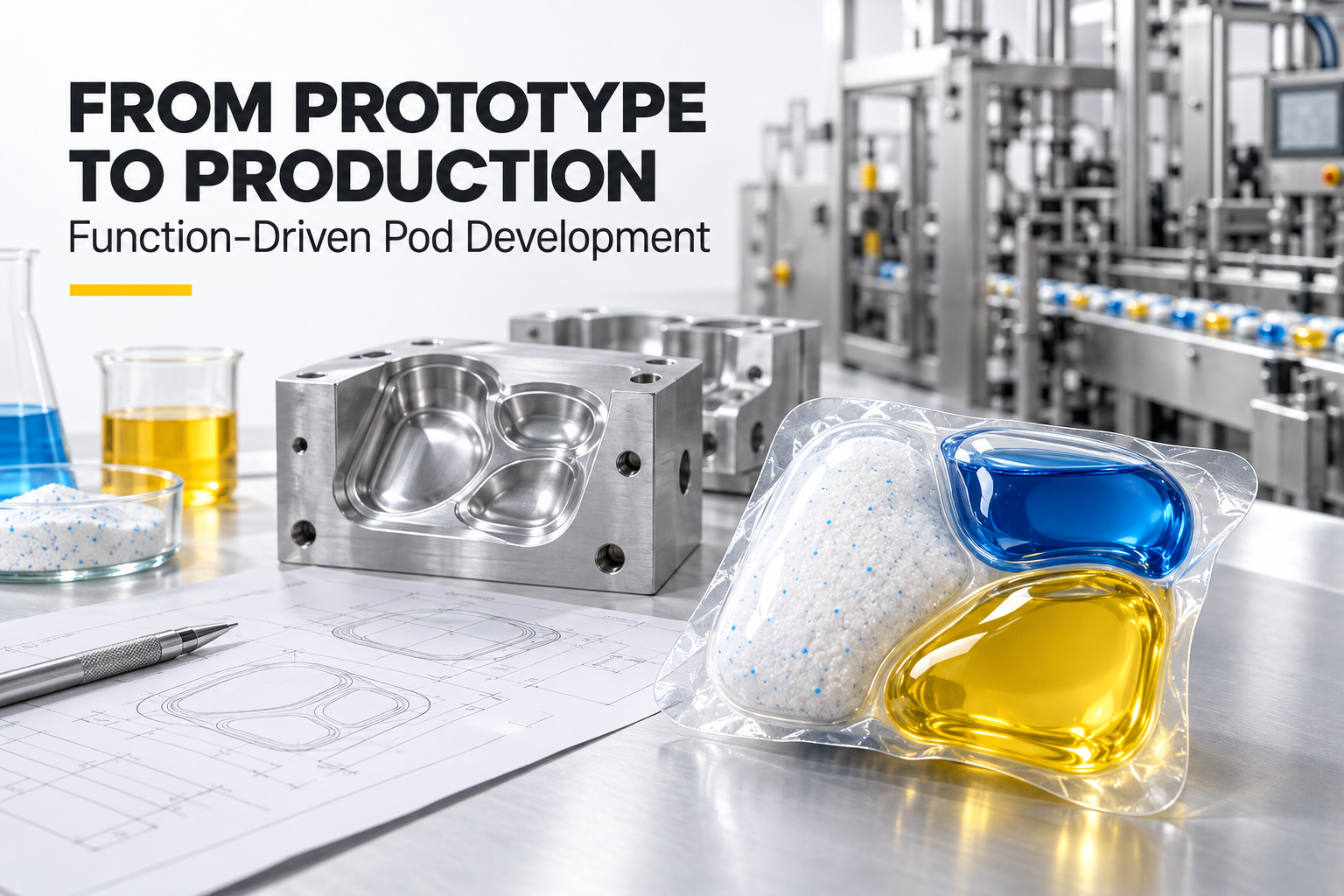
The architecture creates possibilities; development and manufacturing determine whether those possibilities reach the customer. A powder–liquid project should connect the cleaning target to ingredient selection, compartment allocation and a production process that can deliver consistent doses.
- Define the application: identify relevant stains, fabrics, water conditions, temperature and wash cycle.
- Validate storage: assess ingredient activity, moisture sensitivity, film compatibility and interaction between compartments over time.
- Verify delivery: test film and powder dissolution, ingredient dispersion and residue under intended conditions.
- Confirm scale-up: control powder flow, filling accuracy, dust, seal integrity and manufacturing yield.
- Compare results: evaluate cleaning performance and total cost against the existing product at clearly defined doses.
For brands and manufacturers, the strategic value is a platform with more room for development. Powder–liquid pods allow formulation engineers to combine a wider range of ingredients and pursue benefits that conventional formats may struggle to deliver.