
Single-Chamber vs. Multi-Chamber Laundry Pods: Which Is Right for Your Market?
The right number of chambers is not determined by which pod looks most advanced. It depends on what the user needs, how the product will be sold and whether each chamber performs a real formulation function.
Begin with user demand and market competition
A laundry pod is an industrial product and a consumer product at the same time. Its architecture must work in use, but it must also fit the way customers compare and purchase it.
What must the product do?
Consider the washing environment, load size, typical soil level, machine type, water conditions and dosage habits. A fixed-use commercial laundry may value cleaning power, dose simplicity and cost per wash more than visual complexity.
How must the product compete?
Consider shelf density, established brands, private-label pressure, consumer expectations and price tier. In a crowded supermarket, the pod itself becomes part of the packaging and must communicate value before it is used.
The same formulation strategy may be commercially successful in one channel and invisible in another. Architecture should follow the complete market situation—not a universal belief that more chambers are always better.
What each architecture does best
Efficient performance at a lower structural cost
A single-chamber pod can carry a substantial dose in one simple geometry. It normally uses a simpler mold, fewer dosing stations and less sealing area than a multi-chamber product.
- Lower mold and manufacturing complexity
- Higher usable volume within a compact footprint
- Easier filling, sealing and quality control
- More production options and potentially lower MOQ
- Strong fit for value-led or fixed-use applications
A platform for differentiation and function separation
Multiple chambers can create a more recognizable product and allow ingredients or functions to be separated. This provides more freedom for premium positioning and advanced formula architecture.
- Greater shelf visibility and visual recognition
- Clearer communication of multiple benefits
- Separation of incompatible formula environments
- Flexible ratios between cleaning and care modules
- Stronger foundation for premium product claims
The correct choice changes with the sales environment
Commercial laundry or laundromat
In a controlled laundry environment, the operator already understands the dosage and the product is not competing for attention on a crowded retail shelf. The primary requirements may be strong cleaning, a large dose, operational simplicity and low cost per wash.
A large single-chamber pod can be the better engineering choice. More of the product cost goes into detergent rather than extra mold complexity, film, dosing stations or visual decoration.
Supermarket shelf
In a mature retail market, many products may promise basic cleaning. Consumers compare appearance, claims, fragrance, care benefits and perceived technology before purchase.
A well-designed multi-chamber pod can attract attention and give the brand a visible way to communicate cleaning, stain removal, fabric care or fragrance. Here, product architecture contributes to both performance and marketing.
Chamber count is not the same as function count
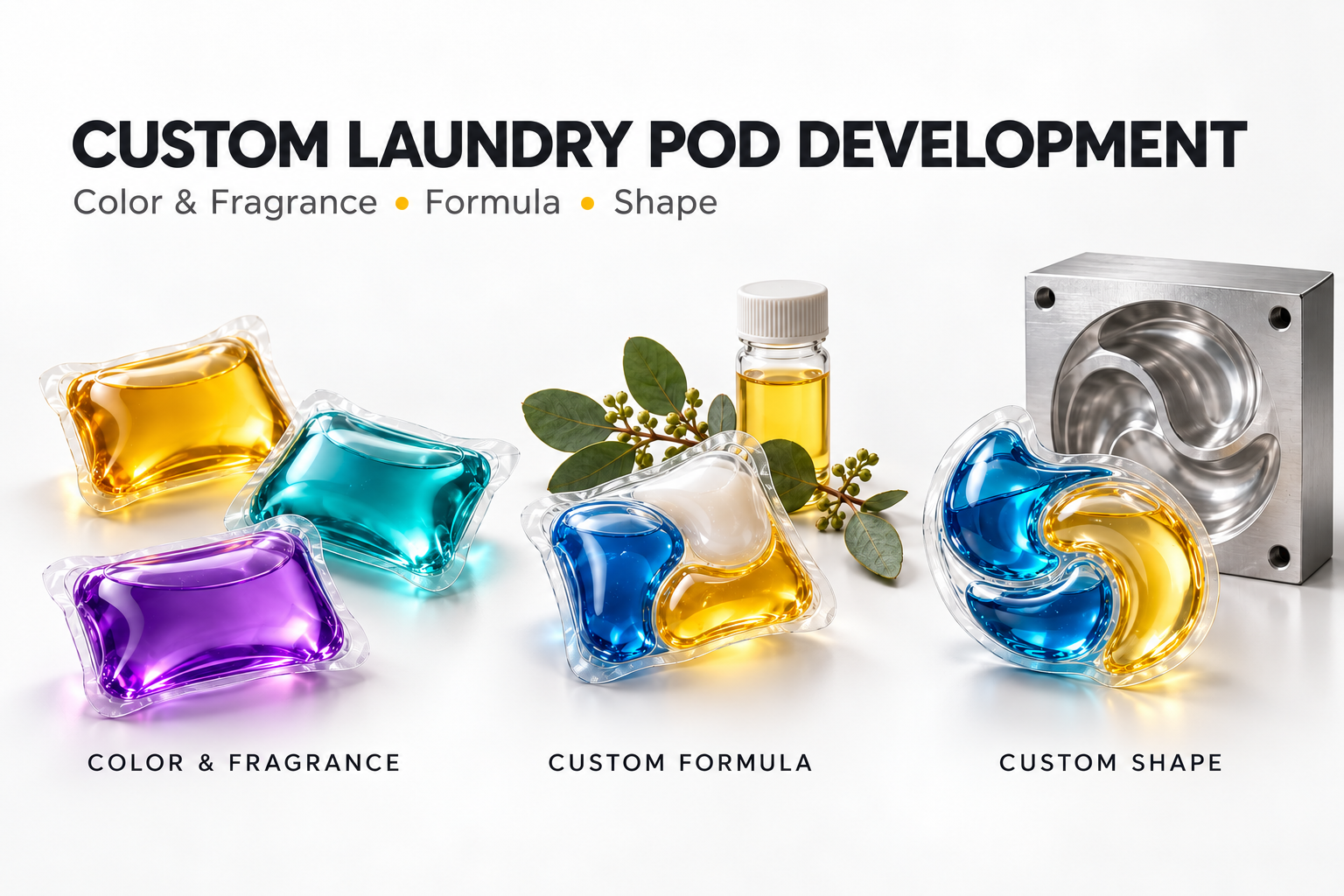
A three-color pod does not automatically provide three different functions. In many products, a similar liquid base is divided into several chambers and only the color changes.
A multi-chamber product needs a formulation reason
- Each chamber should have a defined role or formula environment.
- The selected ingredients should benefit from separation.
- Chamber volume should match the required dosage of each function.
- The complete pod should outperform or communicate more clearly than a single chamber.
- The added value should justify the higher manufacturing cost and complexity.
A sophisticated single-chamber formula can be more effective than a poorly designed three-chamber product. The chamber is only a delivery structure; the formula creates the cleaning result.
Use physical separation to unlock formulation freedom
Multi-chamber technology reaches its highest value when the chambers solve a compatibility, stability, dosage or communication problem that cannot be handled efficiently in one phase.
Compatibility
Separate ingredients that react with each other, lose activity or destabilize the PVA-compatible liquid environment.
Different phases
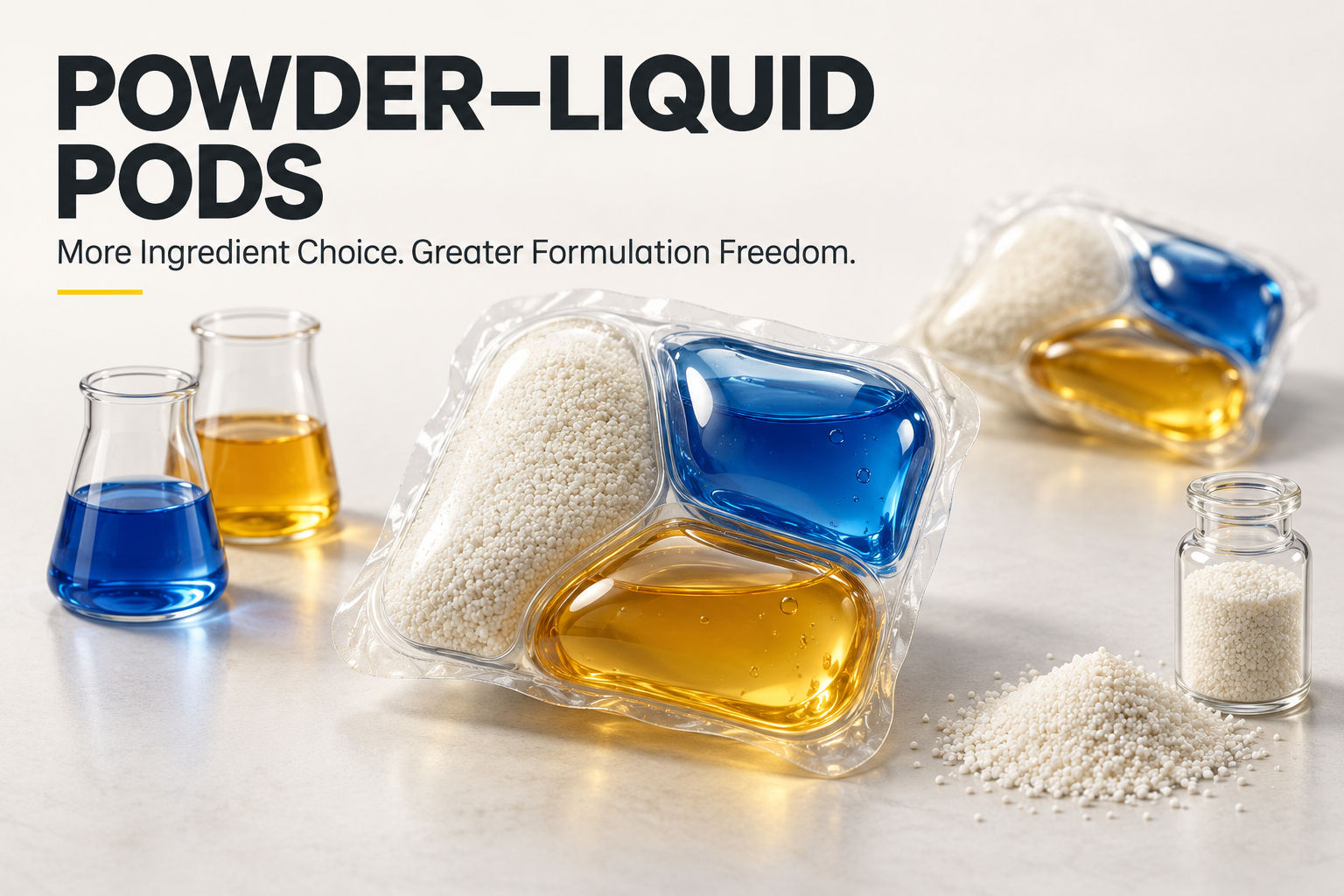
Combine liquid surfactants with powder builders, bleach ingredients, enzymes or catalysts in controlled compartments.
Dosage ratios
Allocate different chamber volumes to cleaning, care, fragrance or specialty modules according to functional need.
Visible value
Make real technical differences easier for consumers, retailers and sales teams to understand and demonstrate.
More chambers create more opportunities—and more constraints
The commercial value of added chambers should be considered together with mold investment, process control and production efficiency.
| Decision factor | Single chamber | Multi chamber | Why it matters |
|---|---|---|---|
| Product cost | Usually lower | Usually higher | More film, sealing area, tooling and dosing control increase cost. |
| Usable dose | Efficient large-volume cavity | Volume divided among chambers | Small chambers must remain large enough to form, fill and seal reliably. |
| Formula freedom | One compatible phase | Several controlled environments | Separation can protect ingredients or combine powder and liquid. |
| Manufacturing | Simpler setup and control | More filling stations and variables | Complexity affects yield, changeover time and quality inspection. |
| Shelf impact | Depends more on packaging | Pod itself becomes a visual asset | Important when consumers compare many similar products. |
| Development need | Can use mature formulas quickly | Requires deeper formula and mold coordination | Each chamber must justify its presence and remain stable. |
Choose according to the value you need to create
When value and efficiency lead
- Cost per wash is the main purchase criterion
- The use environment and dosage are controlled
- A large dose is more important than visual complexity
- The formula is stable in one phase
- Fast launch and broad manufacturing access matter
When differentiation and function lead
- The retail market is mature and visually competitive
- The brand needs multiple clear consumer benefits
- Ingredients benefit from physical separation
- Premium positioning can support higher cost
- The project has sufficient development time and volume
When extra chambers add no real value
- Only the colors are different
- Every chamber contains substantially the same formula
- The benefit cannot be explained to consumers
- The added cost removes price competitiveness
- The factory cannot produce the architecture reliably
Let complexity follow validated demand
A new brand does not need to begin with the maximum chamber count. Architecture can evolve as the product’s market position and technical requirements become clearer.
Starting with a well-designed single- or dual-chamber product can validate demand at lower risk. More advanced powder–liquid or multi-functional structures can follow when consumer response and sales volume justify the additional system complexity.
Chamber count should serve the product strategy
For a value-focused product, a single chamber may provide the best balance of dose, cleaning performance, production efficiency and price. For a premium product in a highly competitive market, multiple chambers can be an effective starting point for stronger visual differentiation and a broader functional system.
The key is to develop the chamber structure and formulation together. Multi-chamber pods reach their full potential only when each chamber has a real role. Otherwise, additional colors and compartments create cost without creating consumer value.
Choose single chamber for efficient value. Choose multi chamber when meaningful separation, stronger functions or clearer market differentiation justify the complexity.
Define the right pod architecture for your market
Yipods can evaluate your target consumer, competitive environment, formula requirements, product cost and manufacturing route to determine whether a single-chamber, multi-liquid or powder–liquid structure is the right choice.