Laundry Pod MOQ Explained: From Product Samples to Commercial Orders
Minimum order quantity is one of the first questions in a private-label laundry pod project. The number is not set only by sales policy. It reflects the minimum volume needed to operate production, formulation, packaging and order management with acceptable accuracy and cost.
Four production realities create the minimum
A laundry pod order is more than the time during which finished pods leave the machine. Every order requires preparation before production and controlled work after production.
High-speed equipment and changeover cost
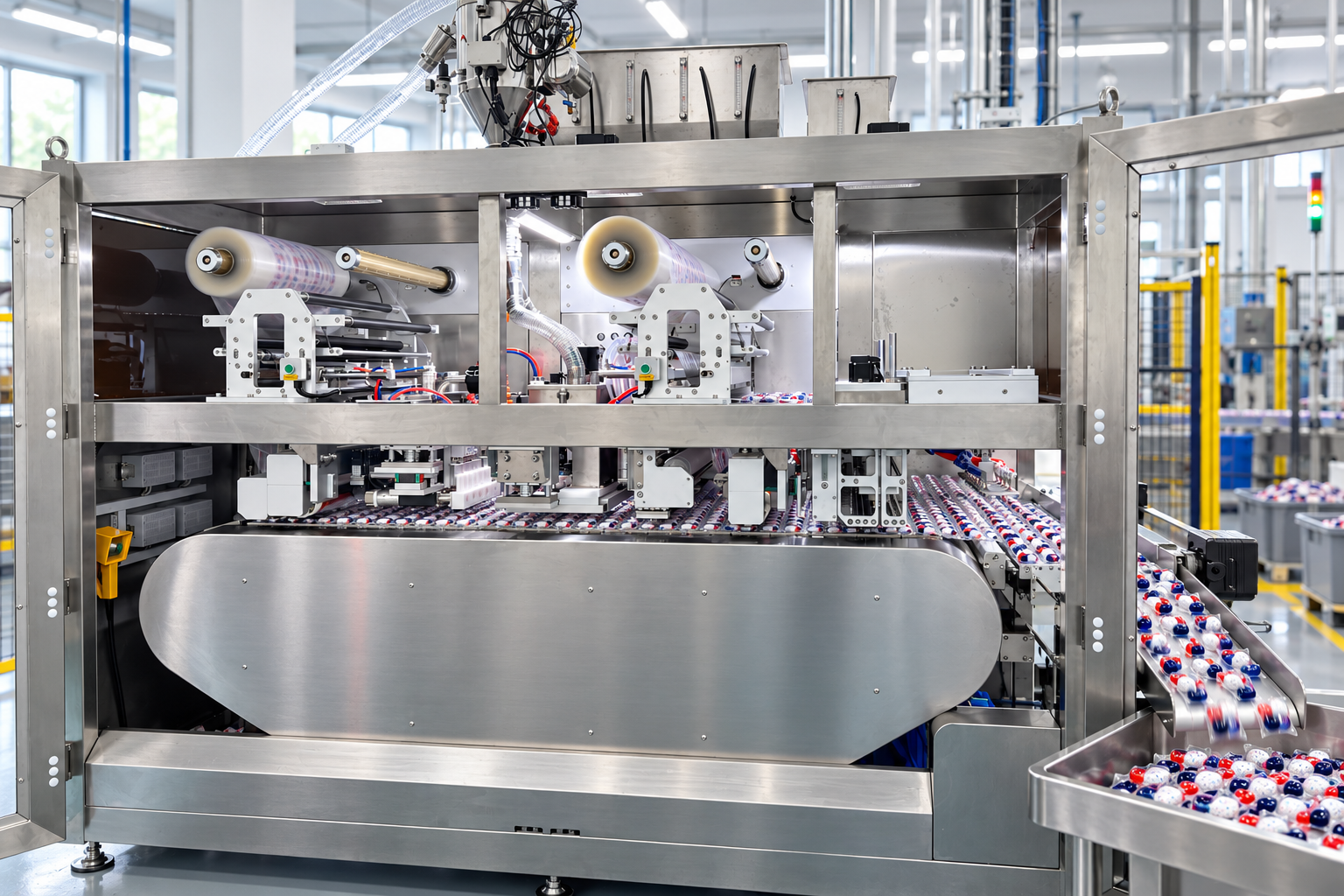
Modern high-speed equipment can produce up to approximately 2,200 pods per minute, depending on the machine and product. A small order may therefore take less time to run than the factory needs to prepare the line.
Changing a product may require cleaning, loading film, installing or adjusting a mold, setting filling parameters, preparing the formula, calibrating doses, starting the line and separating startup waste. These costs exist whether the factory runs for 30 minutes or an entire day.
Formula batching and raw materials
Production formulas are prepared in industrial mixing systems. Some ingredients are added through pumps, dosing systems or weighing equipment that have a minimum accurate operating range. Extremely small additions can increase dosing error.
Raw-material suppliers also impose their own MOQ. A custom fragrance, enzyme, colorant, polymer or functional additive may need to be purchased in a larger quantity than one small pod order consumes.
Packaging production minimums
Printed pouches, cartons, labels and tubs are separate manufactured products. Their suppliers must prepare printing plates, ink, film, cutting, forming or molding processes. Below a certain quantity, the packaging supplier may refuse the order or charge a very high unit price.
For many small projects, packaging—not the pod itself—is the real MOQ bottleneck.
The same factory workflow applies
A small commercial order still needs a quotation, specification, purchasing, scheduling, formula preparation, line clearance, quality checks, packaging, documents and shipment coordination.
Because many administrative and quality-control steps are similar for a small or large order, factories naturally prefer longer, stable production runs that distribute these fixed costs across more units.
Why a small quantity can be inefficient on a fast line
The following calculation uses a nominal output of 2,200 pods per minute. It shows only theoretical running time; actual output depends on product architecture, efficiency and packaging speed.
pods per minute on a high-speed production platform
| Order quantity | Theoretical running time | Practical implication |
|---|---|---|
| 50,000 pods | Approximately 23 minutes | Setup and cleanup may take much longer than production. |
| 100,000 pods | Approximately 45 minutes | Still a very short run for a high-speed line. |
| 1,000,000 pods | Approximately 7.6 hours | Closer to a full, efficient production shift. |
This is why a factory may technically be able to make 50,000 pods but still quote a higher MOQ. The limitation is economic efficiency and process stability, not whether the machine can stop after a smaller number.
Different stages use different production methods
A product sample, a pilot batch and a commercial order should not be treated as the same manufacturing stage. The equipment, objective and unit economics are different.
Product samples
Samples are used to evaluate appearance, fragrance, formula direction and basic feasibility. They may be produced manually, on laboratory equipment or on a small semi-automatic machine.
The cost per pod is not representative of commercial production because engineering and labor are concentrated into very few units.
Pilot or validation batch
A pilot batch checks whether the product can move beyond the laboratory. It may be used for stability testing, packaging trials, limited market testing or buyer presentations.
Flexible equipment and standard packaging can make this stage possible, but the unit price remains higher than a stable commercial run.
Commercial production
Commercial orders use the factory’s normal batching, high-speed production, QC and packaging systems. At this stage, MOQ is determined by the combined economics of formula, equipment and packaging.
Once the product is stable and repeat orders grow, longer runs reduce changeover loss and usually improve the unit cost.
MOQ is set by the tightest constraint
The final MOQ is rarely determined by only one department. It is usually the highest minimum created by one of the following systems.
For example, the pod line may accept a relatively small run, but the printed pouch supplier may require enough packaging for several production batches. In that case, the packaging MOQ becomes the commercial MOQ—or the buyer must finance and store the remaining packaging inventory.
Reduce customization before forcing down the quantity
A lower MOQ is easier when the project uses more of the factory’s existing system. The most effective strategy is often to reduce the number of custom elements during the first launch.
Ways to lower the entry quantity
- Use an existing validated formula
- Select a standard mold and pod weight
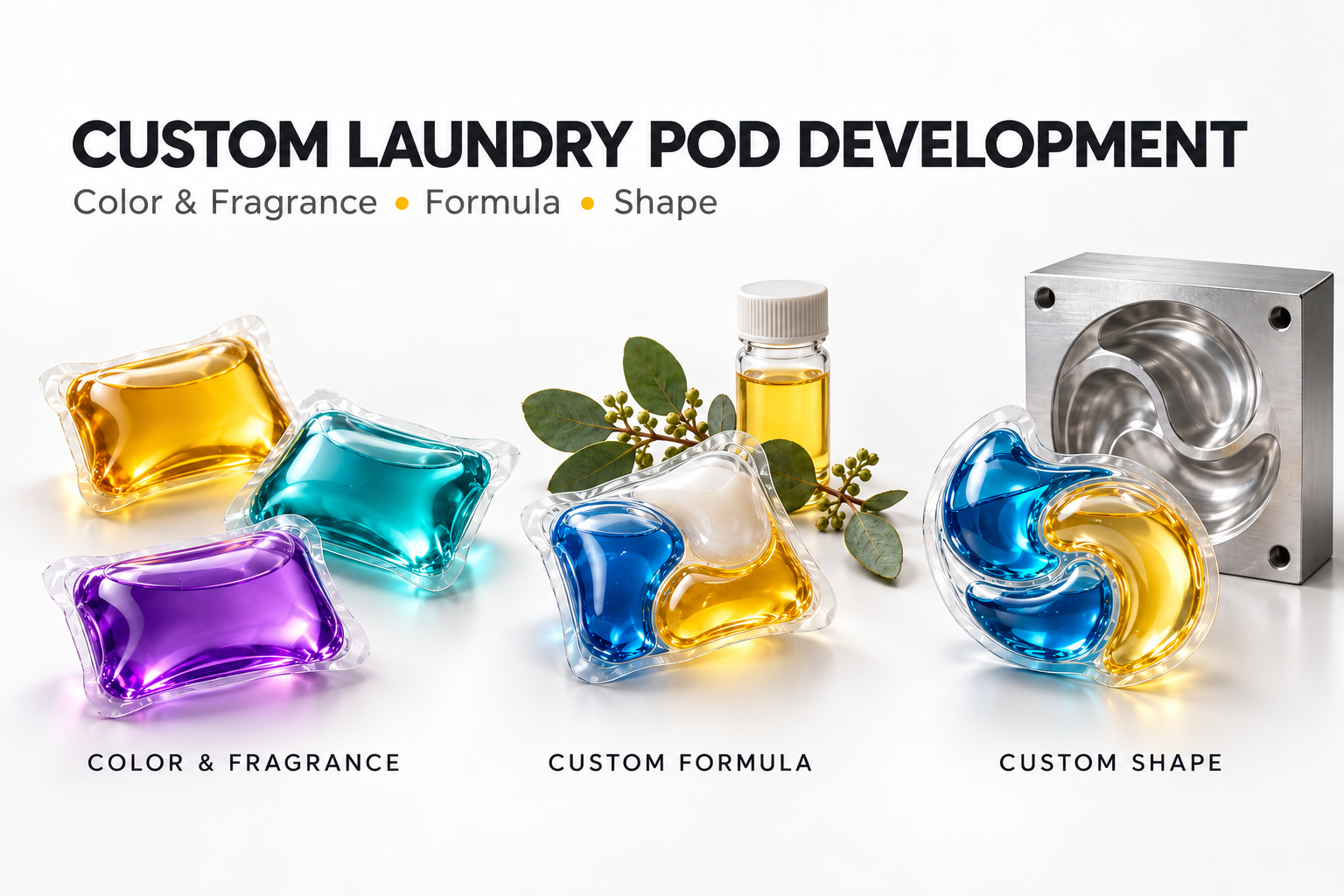
- Use an existing fragrance or color
- Choose a stock pouch, tub or carton
- Apply labels or short-run digital printing
- Launch with one SKU instead of several
- Use flexible or smaller-scale production equipment
Changes that usually raise MOQ
- Dedicated formula and special raw materials
- Custom fragrance or color system
- New chamber structure or mold
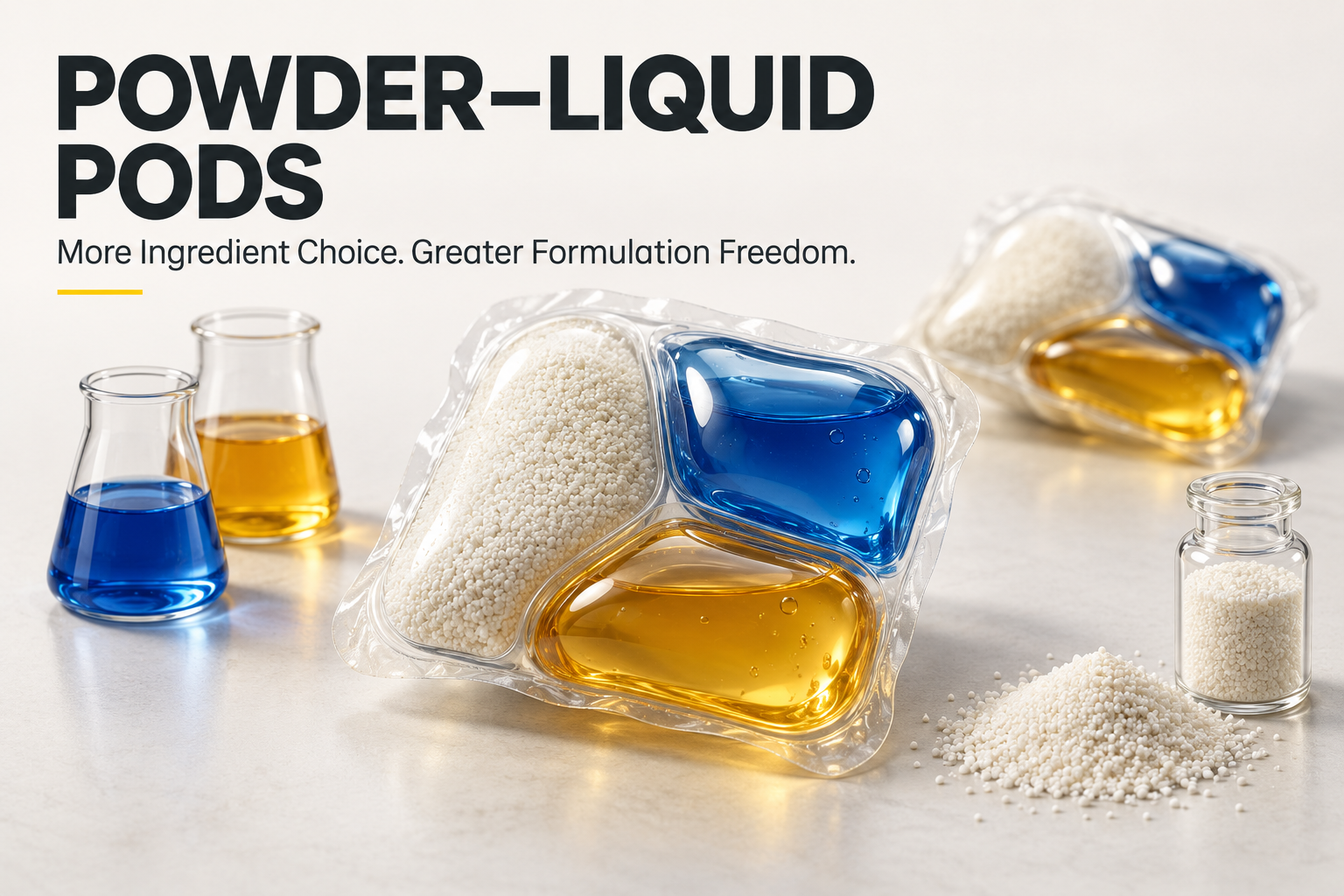
- Powder–liquid or dual-powder architecture
- Fully printed custom packaging
- Multiple SKUs, fragrances or pack counts
- Market-specific certification and testing
MOQ is a system result, not one arbitrary number
A laundry pod factory naturally prefers a large order that can run steadily because stable production distributes setup, cleaning, quality control and administrative work across more units. However, a new brand needs to validate the market before committing excessive inventory.
The solution is to match the development stage with the correct production method: laboratory or semi-automatic equipment for samples, flexible small-scale production for validation, and high-speed lines for commercial volume.
Instead of asking only, “What is your lowest MOQ?”, ask which part of the project creates the MOQ and what can be standardized to reduce it. That question usually produces a more useful and realistic manufacturing plan.
Choose the right route from sample to commercial order
Yipods can match product samples, pilot production and commercial manufacturing with the appropriate formula, mold, packaging and equipment route. Share your target product, pack format and expected volume so the real MOQ constraints can be identified.