How to Choose the Right Laundry Pod OEM Manufacturer
Every laundry pod factory has its own strengths, constraints and operating logic. Those characteristics are often the reason the factory has survived and grown. The objective is therefore not to find a factory that appears strongest in every category, but to find one whose existing capabilities fit your project.
Choose for fit, not reputation alone
Factories in China and other manufacturing markets are not interchangeable. A supplier may be excellent at producing one standardized pod in enormous volume and still be a poor choice for a differentiated, low-volume or technically complex project.
“Which factory is the biggest or cheapest?”
Size may indicate purchasing power and high-volume output, but it does not automatically indicate formulation flexibility, development speed or willingness to support a specialized launch.
“Which factory is already structured for my project?”
A suitable supplier can use its existing equipment, people, materials, certifications and processes to move the product forward without excessive reconstruction.
Do not underestimate the cost of mismatch. If a factory must redesign its line, learn an unfamiliar process, source entirely new materials and create new quality systems for one customer, the buyer ultimately pays through higher cost, longer lead time, repeated trials or unstable delivery.
Define the project the manufacturer must support
Supplier selection becomes much easier when the requirement is specific. “I need laundry pods” is not a useful sourcing brief because two pod projects can demand completely different factory capabilities.
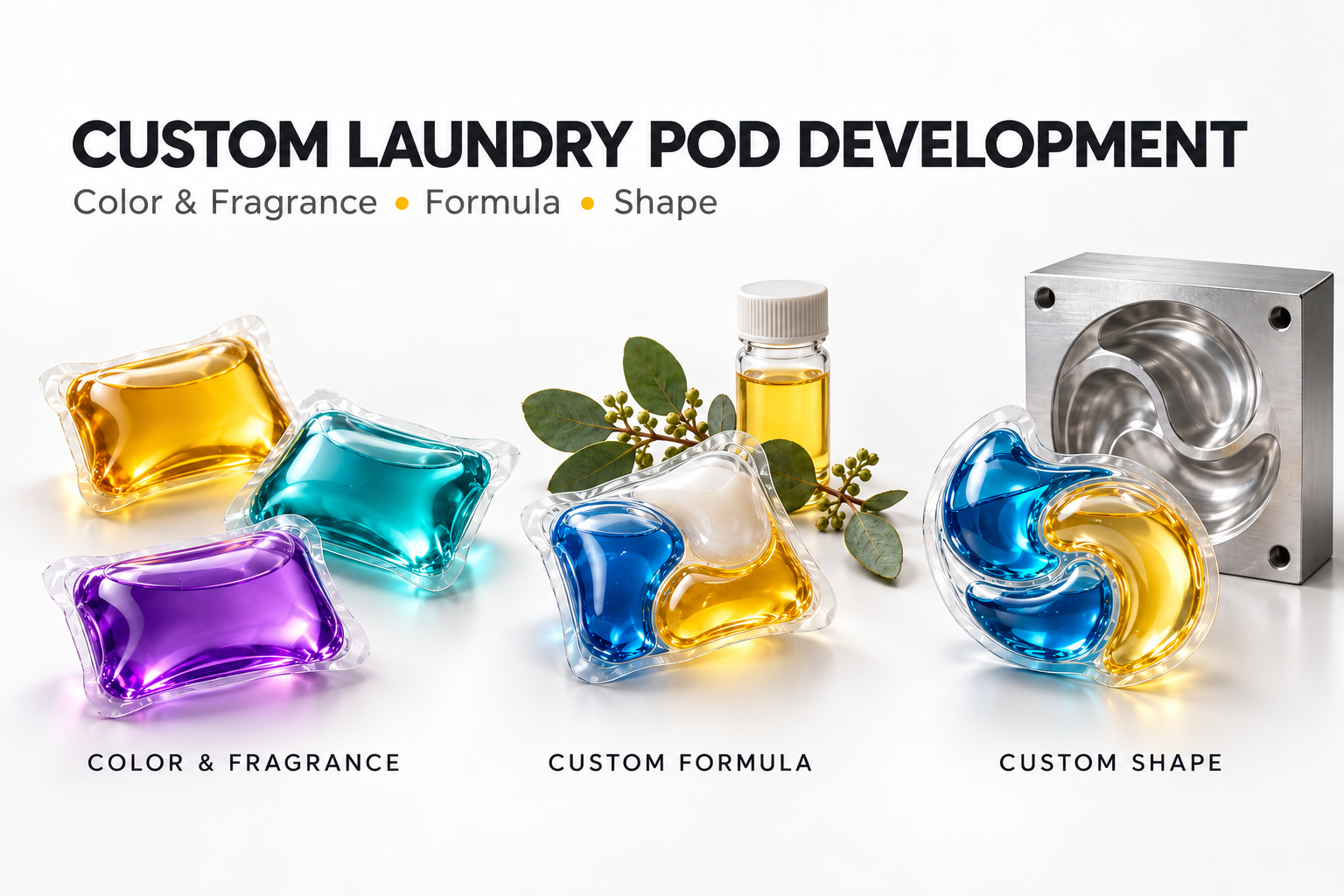
Existing private-label formula, sensory customization, custom formula or new mold and architecture?
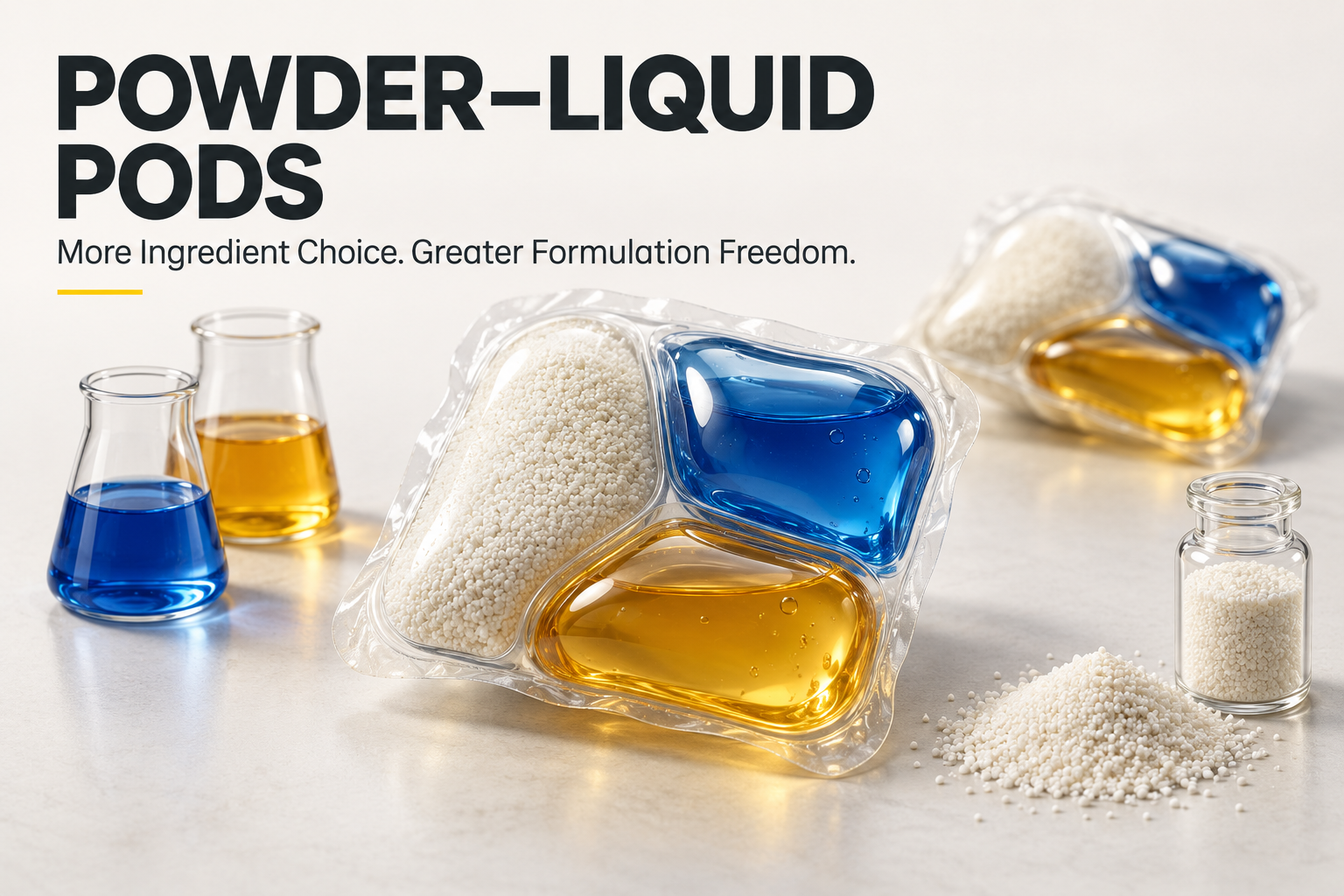
Single liquid, multi-liquid, powder–liquid, dual powder or specialized functional system?
Prototype, market-validation batch, regional launch or continuous high-volume supply?
Required market, certification, packaging format, target cost and delivery date?
A standard private-label launch may need a manufacturer with proven formulas, available packaging and a flexible MOQ. A custom powder–liquid pod may need a different supplier with formulation expertise, powder dosing, specialized molds and a longer validation process. Selecting the supplier before defining the project reverses the correct order.
Evaluate the factory as a system
A reliable OEM decision should separate five capabilities. A supplier can be strong in one dimension and weak in another, so a single factory tour or price quotation is not enough.
R&D capability
Can the team translate a product idea into a stable formula, test PVA compatibility, diagnose failure and balance performance with manufacturability?
Production capability
What structures, chamber counts, materials, fill weights and production speeds can the existing equipment manufacture reliably?
Certification
Do the factory, quality systems, products and documentation support the destination market and the buyer’s retail channel?
Delivery capability
Can the supplier coordinate raw materials, molds, packaging, testing, scheduling and shipment into a dependable delivery?
Speed
How quickly can the team quote, make decisions, produce samples, resolve problems and move between development stages?
Production capacity is not delivery capability
These terms are often treated as if they mean the same thing. They do not.
How much the equipment can make
Production capacity describes output under defined operating conditions. It may be expressed as pods per minute, packs per day or annual tonnage.
- Line speed and available shifts
- Number of machines and molds
- Stable output for an established SKU
- Maximum theoretical or demonstrated volume
Whether the complete order arrives as promised
Delivery capability combines production with the people, materials, decisions and external suppliers required to complete the project.
- Raw-material and packaging availability
- Development and approval lead time
- Changeover and production scheduling
- Quality release, documentation and logistics
A factory may produce millions of pods efficiently once a product is stable, yet take months to approve a new fragrance, modify a formula, build a mold or secure packaging. High capacity can coexist with slow project delivery.
Different projects need different factories
The best supplier profile changes with the maturity, complexity and volume of the product. Trying to force every project into the same type of factory creates unnecessary cost.
| Project type | Most important factory strength | Common mismatch | Suitable supplier profile |
|---|---|---|---|
| Packaging-only private label | Existing product library, packaging coordination and flexible MOQ | Paying for unnecessary R&D or waiting for a factory focused only on huge runs | Flexible OEM platform |
| Color or fragrance customization | Compatibility testing, sensory sourcing and small production changeovers | Factory treats the change as cosmetic and skips stability validation | Development + flexible production |
| Custom formulation | Formulation, PVA knowledge, testing and raw-material management | Production factory has equipment but no team able to convert claims into a stable formula | R&D-led manufacturer |
| Custom mold or multi-chamber pod | Mold engineering, equipment integration and trial capability | Factory must heavily modify a line that was designed for one standard format | Engineering-integrated factory |
| Large standardized retail volume | High-speed lines, purchasing power, QC consistency and schedule discipline | Choosing a small flexible plant that cannot sustain continuous high-volume output | Scale production specialist |
| Powder–liquid or dual-powder system | Specialized dosing, humidity control, formulation separation and advanced molds | Supplier claims capability based on liquid-only production experience | Specialized technical platform |
Why formula and mold projects take longer
A customized project is not one production event. It is a chain of dependent decisions. Delay at one stage moves every stage that follows it.
Factories with slow internal decisions, overloaded technical teams or weak supplier coordination may keep a project waiting between stages. The quoted manufacturing lead time often begins only after formula, packaging, mold and artwork approval, so buyers should request a complete project schedule rather than one final production number.
Ask what the factory has already done
A supplier presentation describes what the company wants to sell. Evidence shows what the operating system can actually deliver.
Ask for comparable proof
- Products with a similar formula and chamber structure
- Actual production samples, not only digital renderings
- Typical yield and stable operating speed
- Examples of previous custom formula or mold projects
- Relevant test records and quality specifications
- Export history to the intended market or channel
Ask how problems are handled
- Who owns formulation and project decisions?
- How are failed trials diagnosed and recorded?
- Who coordinates mold, packaging and raw materials?
- What happens when a material misses its delivery date?
- How are product changes controlled after approval?
- How quickly does the factory communicate deviations?
A factory does not need to have made your exact product before. However, it should have solved comparable technical and operational problems. The further the proposed product sits outside its proven experience, the more contingency, testing time and budget the project needs.
Look beyond the quotation
The lowest unit price can become expensive if development stalls, packaging misses the launch date or the factory cannot reproduce the approved sample.
Technical ownership
Confirm that a named team can explain the formula, film, mold and manufacturing risks—not only a salesperson.
Realistic scheduling
Request milestones for samples, testing, mold, artwork, pilot production and commercial release.
Raw-material control
Understand supplier MOQ, lead time, dedicated inventory and alternatives for critical ingredients.
Changeover flexibility
Check whether the line can switch molds, formulas and pack sizes without disproportionate cost or delay.
Quality consistency
Define measurable standards for weight, appearance, sealing, dissolution, performance and packaging.
Communication speed
Evaluate response quality during sourcing; slow or vague pre-order communication rarely improves after payment.
Use a project-specific scorecard
Do not give every criterion the same weight. A packaging-only launch may prioritize speed and MOQ; an advanced powder–liquid project may prioritize R&D and engineering even if the initial price is higher.
Before choosing, identify the two or three capabilities that can make the project succeed or fail. Weight those factors most heavily, then compare total project risk—not only factory price.
Use the factory’s existing strengths to launch faster
The core advantage of private-label manufacturing is not simply that another company owns a production line. It is the ability to use an existing combination of equipment, formulas, qualified materials, certifications, production knowledge and supply-chain relationships to place a product on the market quickly.
That advantage disappears when the selected factory must be rebuilt around the project. The most efficient route is to match the product with a supplier whose current operating system can support it, then make only the changes that create meaningful consumer value.
A good match reduces development work, shortens the launch path and makes delivery more predictable. That is more valuable than selecting a famous factory that is structurally wrong for the product.
Find the right manufacturing route for your product
Yipods evaluates the product concept, required architecture, expected volume, certifications and launch timetable before recommending a manufacturing path—from flexible private label to custom formulas, molds and powder–liquid systems.